Cart
0
Complete Your Setup





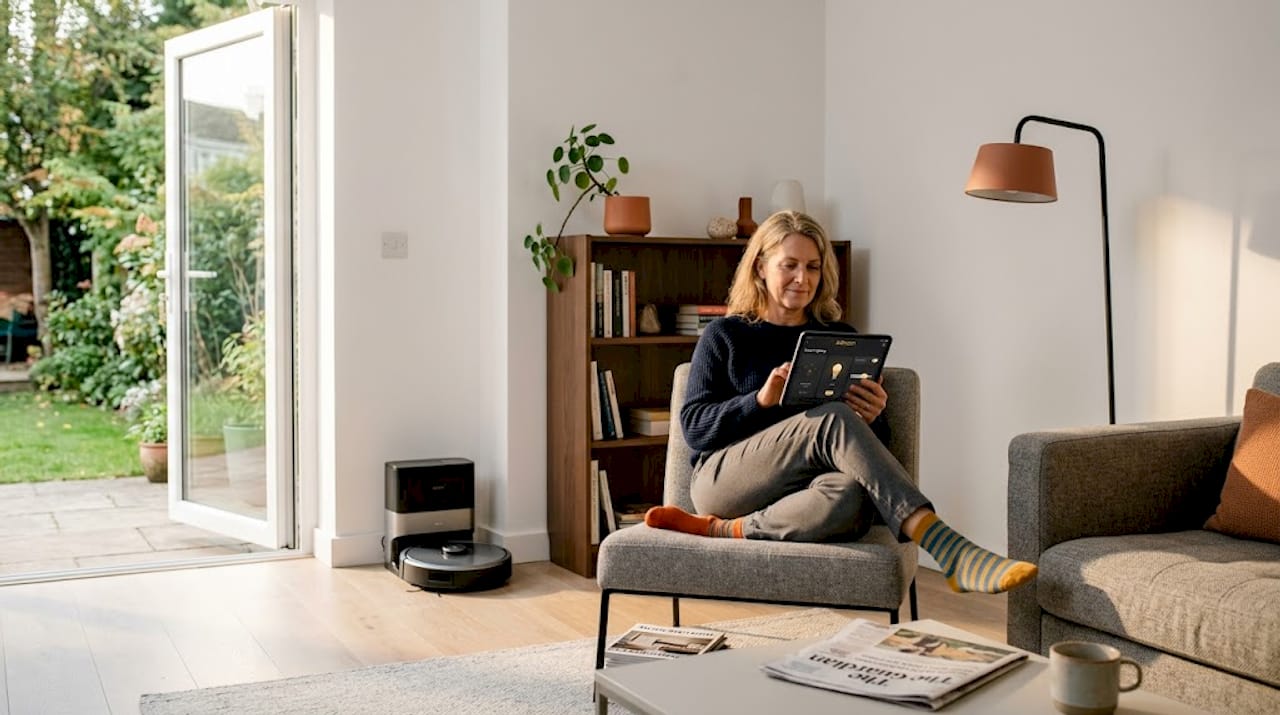
Most people assume a smart home just means buying a smart speaker or a Wi-Fi thermostat. That’s like saying a car is just a seat with wheels. A true smart home is a residence where internet-connected devices work together through a central hub, allowing you to monitor, control, and automate your home’s core systems from anywhere. The real value isn’t in the individual gadgets. It’s in how they coordinate to remove friction from your daily life, save energy, and give you back hours every week.
| Point | Details |
|---|---|
| True smart homes are coordinated | A valuable smart home is defined by systems that work together automatically, not just by having the most devices. |
| Interoperability unlocks simplicity | Standards like Matter let homeowners easily add devices from different brands without headaches or app overload. |
| Automation delivers real efficiency | Smart home routines save time and can cut energy usage by up to a quarter with dynamic, data-driven control. |
| Resilience and usability matter most | The best smart homes keep running smoothly—even if your internet or cloud service takes a break. |
Let’s get clear on what actually makes a home “smart.” The word gets thrown around so loosely that it’s lost most of its meaning. A smart home isn’t defined by how many devices you own. It’s defined by how well those devices communicate, respond, and work on your behalf.
At the core of every smart home are Internet of Things (IoT) devices. IoT simply means physical objects embedded with sensors, software, and connectivity that allow them to exchange data over the internet. Your smart thermostat, door lock, security camera, and robot vacuum are all IoT devices. Individually, they’re useful. Together, they’re transformative.
What ties them together is a central hub or controller, which acts like a traffic manager for your home’s tech. This hub consolidates device management into one place, usually a single app on your phone. Instead of juggling five separate apps for five separate devices, you manage everything from one dashboard. Smart homes allow homeowners to remotely monitor and manage key home systems via apps and controllers, which is exactly the kind of low-effort control busy households need.
Here’s what a well-designed smart home actually delivers:
A smart home isn’t a luxury for tech enthusiasts anymore. It’s a practical system for anyone who wants to spend less time managing their home and more time living in it.
Exploring smart home technology with this mindset, focused on integration rather than gadget collecting, changes how you shop and how you build your setup. Even something as simple as smart lighting features can demonstrate this shift: a smart light switch doesn’t just turn lights on and off remotely. It dims automatically at sunset, turns off when a room is empty, and syncs with your security system when you’re away.
Understanding the fundamentals is one thing. Seeing why coordinated automation delivers so much more value than isolated device control is where it gets genuinely exciting.
Think about how most people use smart devices today. They ask Alexa to turn off a lamp. They check the Ring camera from their phone. They manually adjust the Nest thermostat from an app. These are all useful actions, but they’re still manual. You’re still the one initiating every command. That’s remote control, not a smart home.
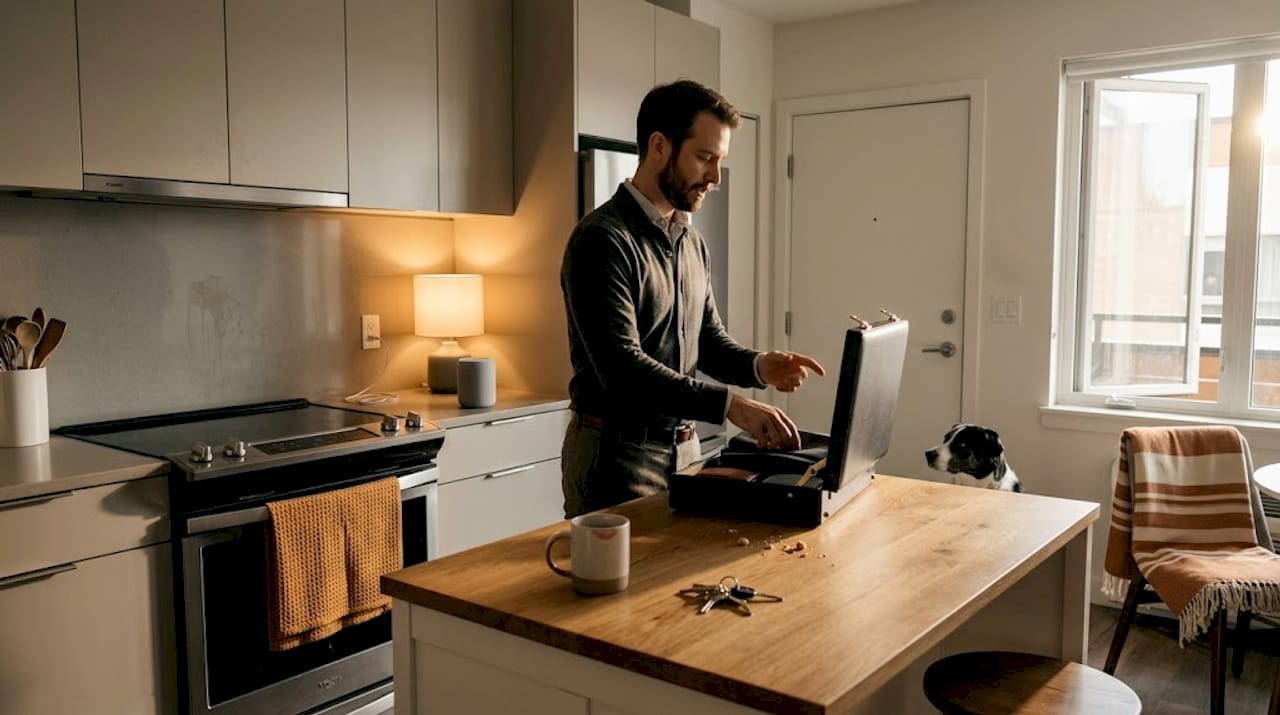
A truly intelligent setup goes further. Modern smart homes deliver intelligence by synchronizing devices and routines, not just by offering remote control. The devices respond to context: the time of day, whether you’re home, what the weather is doing outside, or a custom trigger you’ve defined.
Here’s a real-world example. You leave for work at 8:00 AM. A single “leaving home” routine fires automatically:
You didn’t press a single button. The system recognized you left, and it handled everything. That’s the difference between a collection of gadgets and a genuinely smart home.
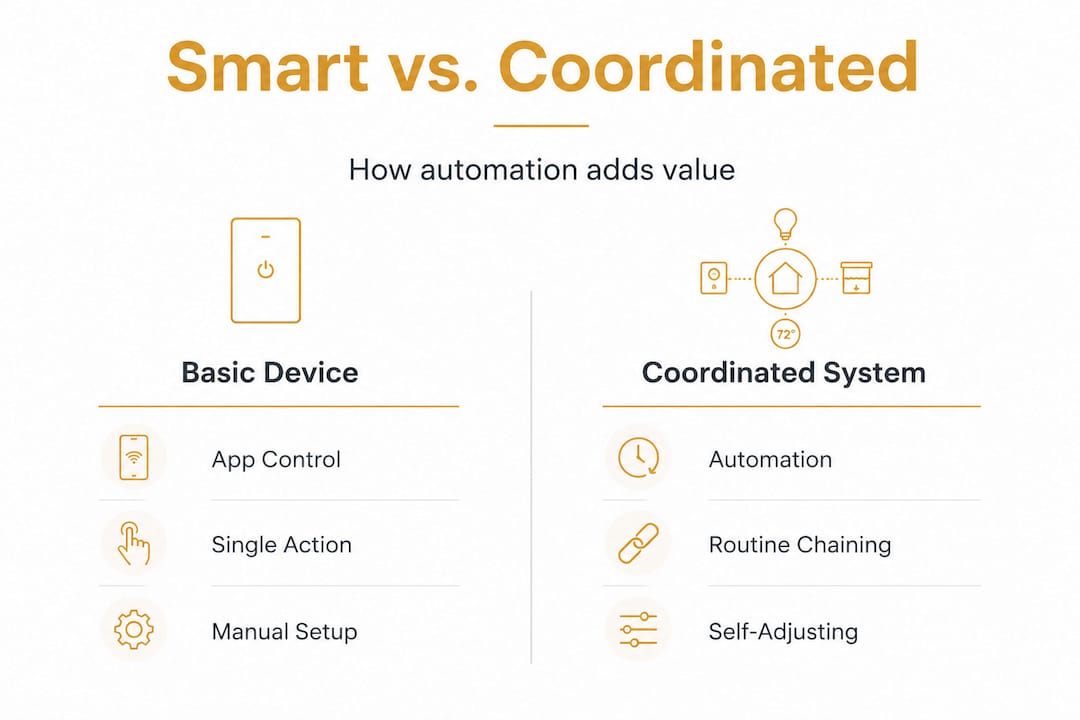
| Feature | Basic smart device | Coordinated smart home |
|---|---|---|
| Control method | Manual app or voice command | Automated routines and triggers |
| Response to context | None | Time, presence, weather, custom triggers |
| Device interaction | Isolated | Synchronized across systems |
| Time saved daily | Minutes | 30 to 60+ minutes |
| Energy efficiency | Marginal | Significant, data-driven |
Busy professionals benefit most from these low-friction automations. When your morning alarm goes off, the lights gradually brighten, the coffee maker starts, and the thermostat bumps up to your preferred temperature. No scrambling. No forgotten tasks. You can even integrate automation in smart homes into cleaning routines, so your floors stay clean without you scheduling a single session manually.
Pro Tip: Start with one high-impact automation, like an “away” routine that handles lights, locks, and thermostat together. Once you feel the difference, building out the rest of your smart home becomes much more intuitive.
Working perfectly together isn’t just a convenience. It’s the foundation of a usable, future-proof smart home. And it’s where most people run into frustration.
Here’s the problem: the smart home market has historically been fragmented. A Philips Hue light bridge doesn’t talk to your Samsung SmartThings hub without workarounds. Your Amazon Echo might not control your Apple HomeKit devices. You end up with isolated “islands” of tech, each with its own app, its own login, and its own quirks. That’s not a smart home. That’s a headache.
Interoperability means the ability of devices from different manufacturers to communicate and work together seamlessly. Connectivity standards like Matter and Thread are critical for integrating devices from different brands into a unified smart home. These standards were developed collaboratively by Apple, Google, Amazon, and Samsung, which means they have real industry backing.
Here’s what Matter and Thread actually do for you:
| Standard | What it does | Benefit to homeowners |
|---|---|---|
| Matter | Universal software compatibility layer | Works across Alexa, Google, Apple without extra steps |
| Thread | Low-power mesh networking | More reliable, fewer dropouts, extends range |
| Wi-Fi | Broadband connectivity | High bandwidth for cameras and streaming devices |
| Zigbee | Low-power device mesh (older standard) | Still widely used, but less universal than Matter |
| Z-Wave | Low-interference mesh (older standard) | Reliable but requires compatible hub |
When you’re shopping for new devices, look for the Matter certification badge. It’s the single best indicator that a device will slot into your existing setup without compatibility headaches. Even products like a connected kitchen sink with smart display features benefit from being part of a broader connected ecosystem rather than operating as a standalone novelty.
Now consider the real outcomes: what do these smart systems actually deliver for your wallet and your busy life? The numbers are more compelling than most people expect.
Energy savings are the most measurable benefit. Smart homes with adaptive, real-time control can cut energy use by an estimated 15 to 25 percent compared to traditionally controlled homes. That’s not a rounding error. On a $200 monthly energy bill, that’s $30 to $50 back in your pocket every single month.
But here’s the important caveat: those savings only materialize when automation is data-driven, not just preset. A thermostat set to run on a fixed schedule isn’t much smarter than a programmable one from 2005. The real efficiency gains come when your system learns your patterns, detects occupancy in real time, and adjusts based on actual conditions rather than assumptions.
Here’s a practical breakdown of where smart homes save time and money:
Stat to know: Homes with real-time adaptive smart controls see up to 25% lower energy consumption compared to homes relying on manual or basic programmable controls.
The time savings are just as significant as the financial ones. When your home handles routine tasks automatically, like locking up, adjusting temperature, running the vacuum, and turning off lights, you reclaim mental bandwidth. For busy professionals managing careers, families, and everything in between, that cognitive relief is genuinely valuable.
Pro Tip: Don’t just automate for convenience. Audit your energy bill first, identify your biggest consumption categories (usually HVAC and water heating), and prioritize automating those. You’ll see a faster return on your smart home investment.
We’ve explored what a smart home can do. Now let’s be direct about what actually separates a frustrating experience from one that genuinely improves your life.
Most new smart home setups underdeliver not because the technology is bad, but because people build around gadgets instead of workflows. They buy a smart bulb because it’s cool. They add a smart lock because it’s on sale. Then they wonder why their home doesn’t feel any smarter. The issue is that individual devices, without intentional automation design, are just expensive remote controls.
The setups that work beautifully share a few common traits. First, they’re built around daily routines, not device categories. The question isn’t “what smart devices should I buy?” It’s “what parts of my day do I want to simplify?” Start there, and the right devices become obvious.
Second, they prioritize platforms with strong interoperability. Locking yourself into a single brand’s ecosystem might feel safe initially, but it limits your flexibility and often means replacing everything when you want to upgrade. Choosing Matter-compatible devices from the start gives you room to grow without starting over.
Third, and this is the one most guides skip entirely, they’re built for resilience. A smart home that stops working every time your internet goes down isn’t smart. It’s a liability. Busy professionals value not just convenience but also resilience, and systems should work even if the internet or cloud service is temporarily unavailable. Look for devices that support local control, meaning they can execute automations without needing to ping a server in another country.
The best smart home investment you can make isn’t the most expensive device. It’s taking 30 minutes to map out your daily friction points, then building automations that specifically address them. That intentionality is what turns a house full of gadgets into a home that genuinely works for you.
You now have a clear picture of what a smart home actually is and how to build one that delivers real value. The next step is finding the right products to bring that vision to life.
At Sabezon, we curate smart home technology designed around real-life workflows, not just impressive spec sheets. Every product we carry is chosen for its ability to integrate smoothly, automate meaningfully, and save you genuine time and effort. Whether you’re starting from scratch or filling gaps in an existing setup, you’ll find solutions that fit. And if you’re ready to extend smart efficiency into the kitchen, our smart kitchen gadgets bring the same connected convenience to meal prep and cooking. Practical, affordable, and built for busy lives.
Smart homes include devices like thermostats, lights, cameras, sensors, hubs, and voice assistants, all managed through connected apps and routines. According to TechTarget’s definition, a smart home uses internet-connected devices for remote monitoring and management of core home systems.
Interoperability enables devices from different brands to work together smoothly, reducing app clutter and future-proofing your setup. Matter and Thread standards ease integration between brands, making it far simpler to expand your smart home over time.
Yes, homes with real-time, data-driven smart automation see up to 15 to 25 percent lower energy use versus traditional controls. Real-time optimization in smart homes drives these savings by adjusting systems based on actual occupancy and conditions rather than fixed schedules.
Automation lets smart homes handle routines like lighting and temperature on their own, saving time and boosting comfort for busy households. Smart home intelligence is best measured by the system’s ability to automate based on time, presence, or customized routines rather than requiring constant manual input.