Cart
0
Complete Your Setup



For most grill cooks, a wireless leave-in probe with two or more channels beats every other option on the market, because it tracks meat temperature without you lifting the lid. For quick sears and thin cuts, an instant-read model still wins on speed. A smart meat thermometer that covers both jobs with multi-probe accuracy and simple app alerts is a practical pick for backyard cooks who want fewer guesses and better results.
TL;DR:
- Wireless multi-probe thermometers excel for long cooks by monitoring meat and ambient temperature remotely, avoiding lid lifts during prolonged smoking or roasting.
- Instant-read thermometers are best for quick, precise checks on thinner cuts like steaks and chicken breasts, providing results in seconds without app reliance.
- Probe material, accuracy within two degrees Fahrenheit, and real-world Bluetooth or Wi-Fi range are critical factors for consistent, reliable grilling measurements.
- Outdoor visibility features such as high contrast screens and adjustable backlighting significantly improve readability in bright daylight or low-light conditions.
- Proper calibration with ice-water tests, weather resistance, and probe durability ensure ongoing accuracy and food safety over multiple grilling seasons.
Grilling is not one activity. It’s a handful of very different tasks that all happen to use the same heat source, and that’s exactly why one thermometer type rarely covers everything you cook.
Long cooks change the math. A pork shoulder on the smoker for eight hours, or a whole turkey riding indirect heat on a gas grill, doesn’t need constant lid-lifting. It needs a probe that stays in the meat and reports back while you’re doing something else, whether that’s mowing the lawn or watching a game inside. That’s when range and remote monitoring stop being a nice extra and start being the reason the cook doesn’t get ruined.
Speed matters just as much, just in a different moment. Searing a ribeye or checking a chicken breast at the tail end of cooking calls for a fast, accurate spot check, not a probe you have to insert and wait on. Wirecutter’s testing found that instant-read thermometers win specifically because they avoid the heat loss and guesswork of repeatedly opening the lid.
Two scenarios make this concrete:
Most serious grillers eventually own both types. The instant-read handles the fast stuff. The leave-in probe handles the long stuff. Trying to force one device to do both jobs is usually where disappointment starts.
Cooking thermometers for grilling break down into a few clear categories, and knowing the difference saves you from buying the wrong tool for your typical cook.
Probe diameter matters too. Thin probes puncture delicate cuts like chicken breasts or fish without leaving a large channel that lets juices escape, while thicker probes tend to be more durable for repeated use on tougher cuts.
Start with accuracy, because a thermometer that’s off by even a few degrees can turn a perfect medium-rare into an overcooked disappointment. Look for stated tolerances in the range of a degree or two Fahrenheit rather than vague marketing language like “highly accurate” with no number attached.
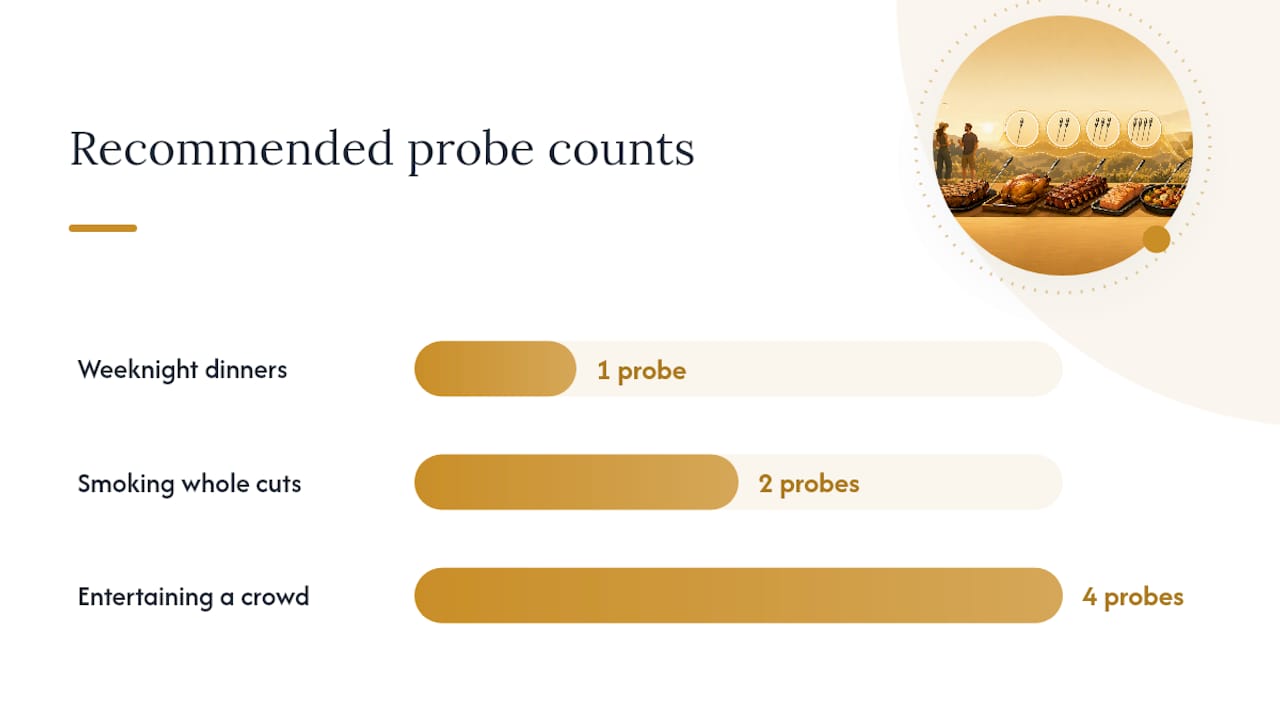
Match probe count to how you actually cook. If you mostly grill weeknight dinners for two, a single probe is plenty. If you smoke whole cuts on weekends and want to track both the meat and the chamber temperature, you need at least two probes, and four gives you room for entertaining a crowd without swapping probes mid-cook.
Test connectivity honestly. Serious Eats found that real-world wireless range in obstructed backyard setups often falls well short of the headline number on the box, so during any return window, walk to the far end of your yard with the grill lid closed and see if the signal actually holds.
Durability outdoors is non-negotiable. Look for an IP rating that reflects splash or rain resistance, since grilling happens outside in weather that indoor kitchen gadgets never face. Confirm the probe itself is rated for high heat, not just the display unit, since a probe left too close to open flame or a pizza-oven-style grill needs a higher heat ceiling than one used only for indirect cooking.
Power source affects how the thermometer fits your routine:
Before buying, test the basics: is the display readable at arm’s length in direct sun, does the app stay connected through a full cook, and is the alert loud enough to hear from inside the house?
Pro Tip: Confirm accuracy yourself before trusting any thermometer for a big cook. Dunk the probe in an ice-water bath, which should read close to 32°F, as Food Network’s test kitchen recommends. If it’s off by more than a degree or two, recalibrate or return it.
Red flags to walk away from: no stated accuracy tolerance anywhere in the listing, probes with no maximum temperature rating, and wireless claims with zero mention of real-world (versus line-of-sight) range.
Specification sheets are full of numbers, but only a handful genuinely affect how your food turns out. Here’s what to actually weigh before checking out.
Price tends to track features in a predictable pattern: budget instant-reads under $20 usually skip accuracy calibration data entirely, mid-range models in the $30 to $60 range typically add tighter tolerances and better displays, and multi-probe wireless systems above $80 add app connectivity, gateway range, and more probes per unit.
Matching the tool to the task is where most of the frustration in grilling actually gets solved.
This guide comes from Tony at Sabezon, built around independent testing standards from outlets like Serious Eats, Food Network, and Wirecutter rather than marketing copy alone.
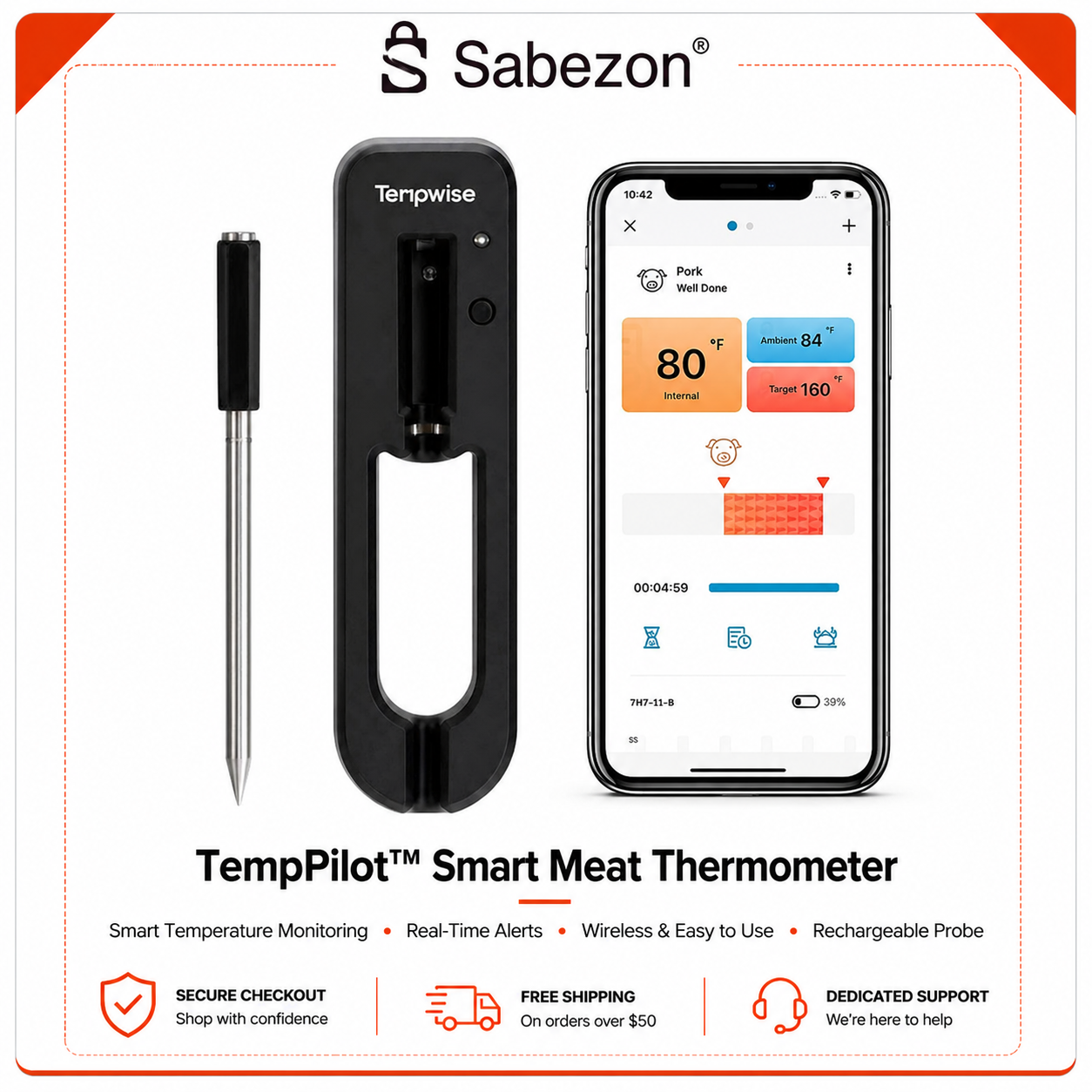
Sabezon focuses on smart home gadgets that solve everyday problems without overcomplicating them, and grilling accuracy is one of those problems. The TempPilot™ Smart Meat Thermometer was built around the same checklist covered above: real accuracy tolerances, multiple probes for long cooks, and connectivity that holds up in a normal backyard.
Calibration drift happens to every thermometer eventually, usually from repeated temperature swings or a hard drop on the patio. The fix is simple and takes under a minute.
Run the ice-water test regularly, not just once at purchase. Fill a glass with ice, top it with water, stir, and let the probe sit for about thirty seconds. It should read close to 32°F. If it’s reading several degrees off, most digital models have a calibration adjustment in the settings menu or a small calibration nut on analog dial models. If there’s no way to adjust it, that’s a sign to replace the unit rather than trust it for another cook.

Between cooks, wipe the probe with warm soapy water or a sanitizing wipe rather than submerging the entire unit, since most probes are heat-resistant but not fully waterproof at the base or display. Check the cable on wired models for cracking near the connector, which is the most common failure point after repeated heat cycles.
Store the thermometer somewhere dry rather than leaving it clipped to the grill lid outdoors, since humidity and temperature swings shorten battery life and can fog up display screens over time. Replace batteries before a long cook rather than during one. A dead probe halfway through a brisket is the kind of problem nobody wants to troubleshoot at 2 a.m.
Grill type changes what you should look for more than most buying guides admit.
Charcoal grills run hotter and less evenly than gas, with hot spots that shift as coals burn down. A thermometer with a high-heat-rated probe matters more here, and an ambient probe helps you track chamber temperature separately from the meat, since charcoal temperature swings more than gas.
Gas grills offer steadier, more predictable heat, which makes single-probe monitoring more reliable and reduces the need for a dedicated ambient probe in most quick-cook scenarios.
Pellet grills already include a built-in temperature readout for the chamber, but that factory gauge is often less accurate than a dedicated meat probe, and pellet cookers benefit heavily from wireless leave-in probes since most low-and-slow pellet cooks run for hours with the lid closed the entire time.
Across all three grill types, the metal lid itself is the biggest wireless signal blocker you’ll run into. A probe transmitting through a closed steel lid loses more range than one used on an open smoker or a grill with a mesh or glass window, which is worth testing at home before you assume a wireless model won’t reach your patio chair.
A thermometer with excellent accuracy is useless if you can’t read the screen in bright daylight, and this is one of the most overlooked specs on any listing.
Digital displays dominate the market now, and for good reason: they show exact numbers instantly rather than requiring you to interpret a needle position like older analog dial thermometers. Analog dials still show up on some budget grill-mounted gauges, but they’re harder to read precisely and slower to respond to temperature changes.
Backlighting matters more than most buyers expect. Evening cookouts and early morning briskets both put you in low light, and a screen without backlighting forces you to use your phone flashlight just to check a number. Look specifically for adjustable brightness, since a screen that’s too dim in daylight or too bright at night is equally annoying.
Screen contrast in direct sunlight separates good displays from frustrating ones. Some digital screens wash out completely under midday sun, while others use high-contrast numerals specifically designed to stay legible outdoors. If a product listing doesn’t mention outdoor readability at all, treat that as a gap worth asking about before buying.
Probe hygiene doesn’t get much attention in most buying guides, but it directly affects food safety every time you use the thermometer.
Look for probes made from food-grade stainless steel, the same standard used in kitchen utensils and cookware. This material resists corrosion, doesn’t react with acidic marinades, and holds up to repeated cleaning without pitting or rusting at the tip.
Cross-contamination is the real risk with any probe used across multiple pieces of meat during one cook. Wipe the probe clean between insertions, especially when moving from raw poultry to another cut, since a probe carries bacteria on its surface just like a knife or cutting board does. Warm water and dish soap handle this fine for most probes; avoid submerging the connector end or the display housing unless the product specifically states it’s fully waterproof.
Check probe tips for a smooth, rounded design rather than a rough or pitted surface, since a pitted tip is harder to clean thoroughly and can harbor bacteria in tiny grooves after repeated use. Replace a probe once the tip becomes visibly worn, discolored, or bent, since a damaged tip both reads less accurately and cleans less effectively.
Most buying guides treat this like a single-winner competition, and that’s the wrong frame entirely. The real question isn’t which thermometer is best. It’s which combination of instant-read and leave-in probe actually matches how you cook.
The conventional advice oversells wireless range and undersells basic accuracy. A thermometer with a flashy app and a four-probe count is worthless if it’s reading three degrees hot, and plenty of listings never state an accuracy tolerance at all, which should raise more suspicion than it currently does among shoppers.
If you take one thing from this guide, prioritize accuracy tolerance and probe durability before you ever look at app features or design. Predictive doneness alerts and slick graphs are genuinely nice, but they’re decoration on top of a device that either reads temperature correctly or doesn’t. Get the fundamentals right first, and the extra features become a bonus rather than a distraction from what actually matters at the grill.
— Tony
Sabezon built the TempPilot™ around the exact checklist covered in this guide, so you’re not choosing between accuracy and convenience.

A smart meat thermometer pairs multiple probes with a simple app connection, which means you get continuous readings on a long smoke and a fast, reliable check on a weeknight steak from the same device. In the box, you’ll find the probe set, the base or app-pairing hardware, and a display readable enough to check from across the patio without squinting. It fits grill cooks who want one dependable tool instead of juggling a drawer full of half-working gadgets, whether you’re smoking a pork shoulder all afternoon or searing dinner in ten minutes flat.
If you’re sourcing quality cuts to put that accuracy to work, Pat’s Prime Cuts & Deli’s catering services is a solid option for anyone stocking up before a big cookout.
Browse the TempPilot™ product page to check current specs and pricing, or explore the full Smart Kitchen collection for other tools built to make everyday cooking easier.
For most grill cooks, a wireless multi-probe leave-in thermometer covers the widest range of cooks, while an instant-read model remains the fastest option for quick spot checks on steaks and burgers.
A meat thermometer measures internal food temperature, not the air temperature inside the grill; if you want to track chamber or ambient temperature too, you need a model with a dedicated ambient or pit probe.
“Meat thermometer” and “cooking thermometer” are generally used interchangeably, though “cooking thermometer” is the broader industry term that also covers candy, oil, and oven-air temperature use.
A smart thermometer with app connectivity, multiple probes, and a stated accuracy tolerance under ±1.8°F is the strongest pick for grillers who want remote alerts; Sabezon’s TempPilot™ Smart Meat Thermometer is built around that exact combination.
Run the ice-water test: submerge the probe tip in an ice-water bath for about thirty seconds, and it should read close to 32°F; anything off by more than a degree or two suggests it needs recalibration.