Cart
0
Complete Your Setup


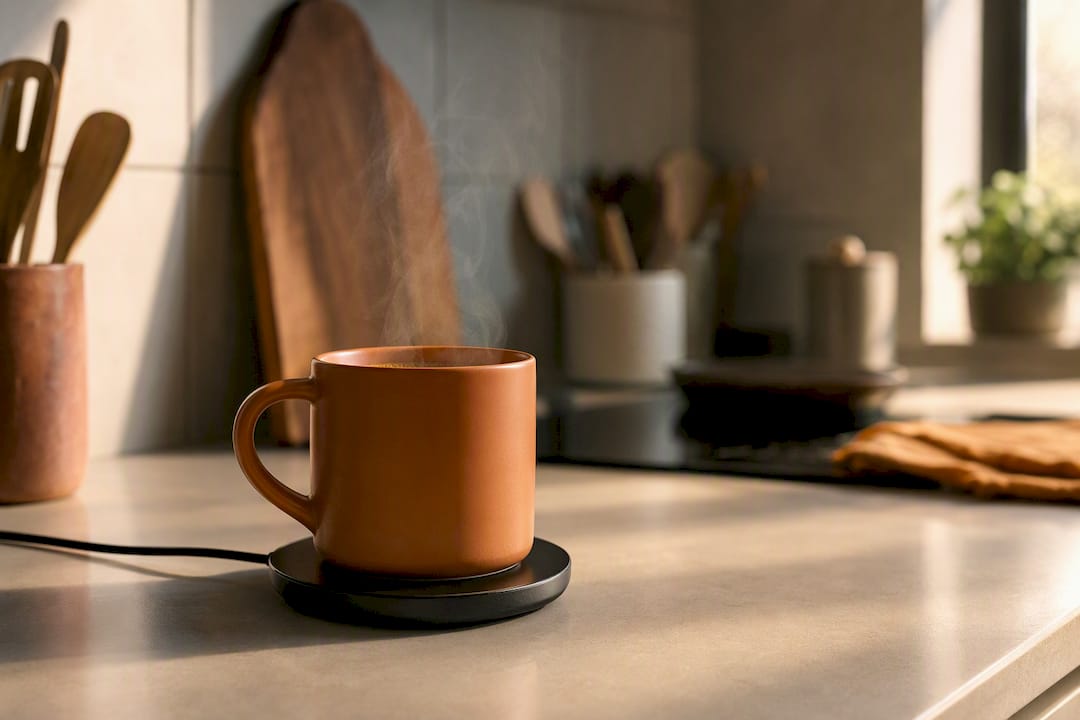
For most desks, the Amora™ Mug Warmer is the mug warmer for office use worth buying. It has a compact footprint that fits next to a keyboard, three temperature settings so you can match hot cocoa or black coffee, and an auto-shutoff that keeps it safe next to a laptop all day. It works with any standard flat-bottomed ceramic or glass mug, which covers the mug already sitting on your desk right now.
If you want other options, two quick picks:
Two caveats before you buy anything: check that your mug has a flat, thin bottom, and know that vacuum-insulated travel mugs mostly won’t warm at all. Their whole design blocks heat transfer, which is the opposite of what a warmer needs to do.
A reliable mug warmer for office use needs auto-shutoff, flat-bottomed mug compatibility, and a temperature setting matched to your drink, and the Amora™ Mug Warmer delivers all three in a desk-ready size.
| Point | Details |
|---|---|
| Match mug to warmer type | Use flat-bottomed ceramic or glass mugs; vacuum-insulated tumblers won’t warm effectively. |
| Prioritize safety features | Choose units with auto-shutoff and basic certification like UL or FCC compliance. |
| Understand the limits | A warmer holds temperature, it does not reheat a fully cold drink back to piping hot. |
| Estimate running cost easily | Multiply wattage by daily hours used and your local kWh rate for a near-zero cost estimate. |
| Recommended office pick | The Amora™ Mug Warmer offers three temperature settings, a compact footprint, and auto-shutoff built for desk use. |
A mug warmer changes one small but constant annoyance: the moment, usually around minute 12, when your coffee goes from hot to lukewarm and you either drink it anyway or get up to microwave it.
Reheating in a microwave doesn’t just cost you a walk. It also tends to cook the drink unevenly and can push delicate flavor compounds in coffee and tea past their ideal range, which is part of why editorial testers consistently favor holding a drink at a steady serving temperature over blasting it back to hot in short bursts, according to Wired’s coffee and mug warmer testing. Keeping a drink at a stable warm temperature, rather than cycling hot, cold, reheated, cold again, is simply gentler on both the drink and your attention span.
For desk workers specifically, the practical wins stack up:
None of this requires a fancy device. It just requires something that holds a consistent temperature under your cup while you work.
Three main styles dominate the mug warmer for office category: plate-style hot plates, induction or magnetic coasters, and self-heating smart mugs. Plate warmers suit anyone who wants to use their own mug and keep costs low. Induction systems suit anyone who wants more even heat without touching electronics. Self-heating mugs suit anyone who moves around the office a lot and needs the heat source to travel with them.
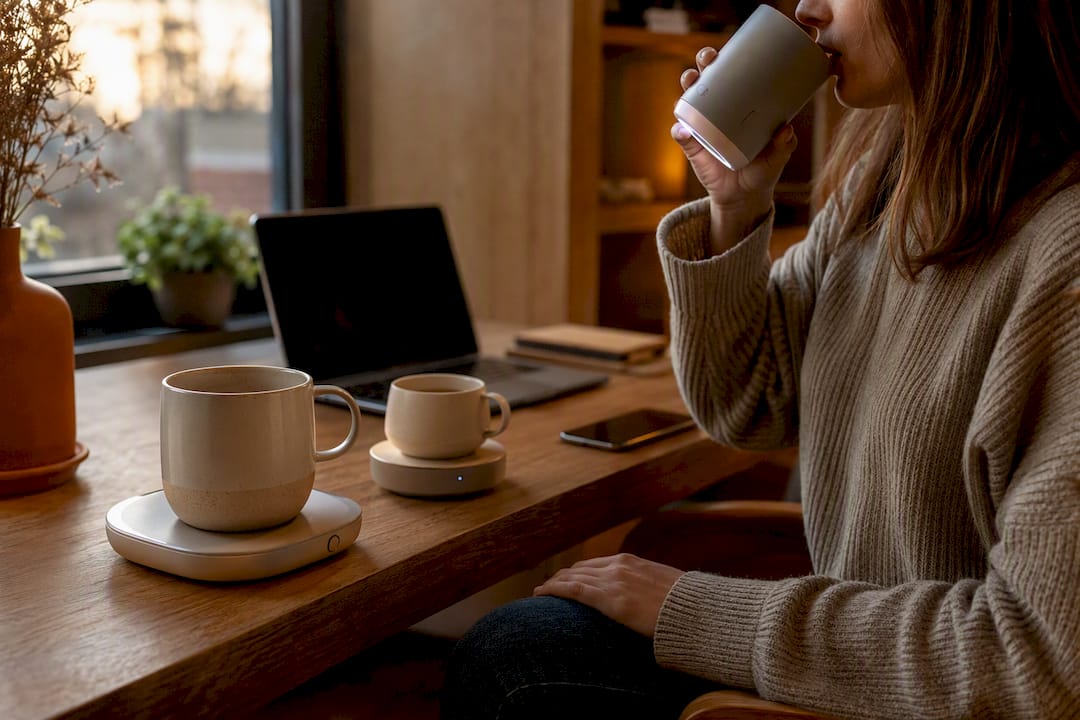
Plate-style warmers use a heated surface, usually tempered glass or coated metal, that transfers heat directly through the base of your mug. They’re the most common style you’ll see, and for good reason: they’re simple, inexpensive, and compatible with almost any mug you already own. Editorial testing found plate-style warmers perform best with thin-walled, flat-bottomed ceramic mugs, since a flat surface makes solid contact with the plate and transfers heat efficiently, according to Allrecipes’ mug warmer testing. They’re also the easiest to clean, since there’s no cup electronics involved, just a wipeable surface.
Induction or magnetic coasters heat the mug itself through an electromagnetic field rather than direct surface contact. Food & Wine’s testing on hybrid systems like the OHOM Ui 3 found this approach delivers more consistent temperature control and better energy efficiency, without needing to embed any electronics inside the mug itself, based on Food & Wine’s coffee mug warmer tests. That last part matters: you get even heating without paying for a proprietary cup. The tradeoff is a higher price and, on some models, a narrower range of compatible mugs.
Self-heating smart mugs flip the whole model. Instead of a plate that heats the mug, the mug itself has a battery and heating element built in. Wired’s testing draws a clear line here: self-heating mugs are genuinely portable since you can carry them from your desk to a conference room, but they’re usually locked to a specific proprietary cup rather than working with whatever mug is already in your cabinet, per Wired’s testing. If you rarely leave your desk, that portability is wasted money. If you bounce between meeting rooms constantly, it might be the better fit.
Here’s how the three stack up side by side:
Pro Tip: Stick with flat-bottomed ceramic or glass mugs on plate and induction warmers. Vacuum-insulated stainless steel mugs are built specifically to resist heat transfer, which is exactly what makes them terrible on any external warmer.
The short answer: match the warmer’s footprint, power source, and safety features to how your desk actually works, not to whichever unit has the most settings on the box.
Run through this checklist before you commit:
Before you check out, ask these quick questions:
Watch for these red flags in product listings:
Many office-oriented warmers also include a gravity or pressure sensor that only activates the heating element when a mug is actually resting on the plate, then drops to sleep mode once you lift the cup, a common convenience feature described in product listings for pressure-activated warmers. It’s a small feature, but it matters for standby energy use and for not leaving a bare heating plate exposed when nothing’s on it.
Running cost is genuinely small. A typical desk mug warmer draws single-digit to low double-digit wattage, and you can estimate your own cost with one multiplication: wattage × hours used per day × your local electricity rate per kilowatt-hour, based on typical desk warmer specs. A 16-watt warmer run for 8 hours a day works out to about 0.128 kWh daily, which at a common residential rate lands well under a dime a day. Even running it every workday for a month costs less than a single coffee shop latte.
The Amora™ Mug Warmer earns its spot as the top recommendation for office use because it solves the three problems that actually annoy desk workers: it takes up almost no space, it doesn’t force you into a proprietary cup, and it won’t overheat if you forget it’s on during a long call.
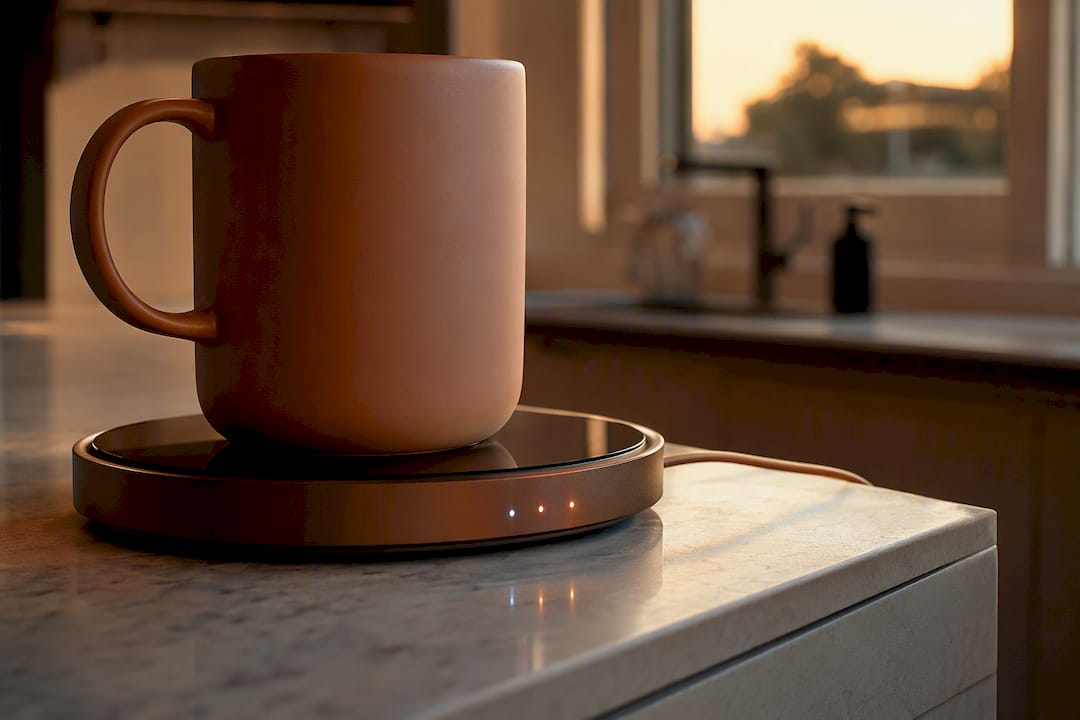
Three temperature settings mean you can dial in something closer to 104°F for a delicate green tea or push toward the top end for black coffee that stays properly hot. The auto-shutoff protects both your drink and your desk, since you never have to remember to switch it off before you head to a meeting. The surface wipes clean in seconds, which matters more than it sounds like it should once you’ve dealt with a sticky ring left behind by a spilled latte.
| Spec | Detail |
|---|---|
| Temperature settings | 3 adjustable settings |
| Footprint | Compact, desk-friendly diameter |
| Power input | USB and standard wall-plug compatible |
| Surface material | Easy-clean, wipeable finish |
| Safety feature | Automatic shutoff |
| Mug compatibility | Standard flat-bottomed ceramic and glass mugs |
| Best for | Desk, travel, and home office use |
Quick specs worth noting before you shop:
Think about who actually reaches for this kind of warmer. A hybrid worker who splits time between a home office and a downtown building wants something light enough to toss in a bag, and the Amora™'s compact size handles that without a second thought. A remote worker with a small desk setup, maybe a corner of the kitchen table doubling as a workstation, needs something that doesn’t eat up the little surface area available. A commuter who brings the same travel-ready plate to whichever desk they’re assigned that week wants consistency more than bells and whistles, and three clear temperature settings deliver exactly that.
Pro Tip: If your desk mug rotates between tea and coffee, keep the warmer on its middle setting by default. It’s warm enough for coffee and gentle enough not to scorch delicate tea, so you’re not adjusting the dial every time you switch drinks.
Testing plate-style warmers shows a consistent pattern: they don’t reheat a cold drink quickly, but they hold an already-warm drink at temperature for hours without much drama.
Here’s the general process:
A gravity-activated sensor is common in office-oriented models, meaning the plate only actively heats when it detects a mug’s weight pressing down, based on pressure-sensing warmer designs. One quirk worth knowing: extremely lightweight mugs can sometimes fail to reliably trigger these sensors, so if your favorite mug is unusually light, check for a manual on/off option as a backup.
What this setup does not do: reheat a drink that’s already gone cold back to piping hot. That’s a common overpromise in cheaper listings, and it’s worth calling out before you buy based on marketing copy alone. What it also doesn’t tell you is how the unit performs after a year of daily use, since normal testing windows don’t cover long-term electronic failure rates or how the heating element holds up after thousands of on/off cycles.
Always place a mug warmer on a flat, stable surface, and favor models with a stated auto-shutoff and basic safety certification. That single habit prevents most of the rare problems people run into with these devices.
Skip these behaviors entirely:
Cleaning depends on the surface material:
Before you step away from your desk for the day, run a quick mental check: unplug the unit if you won’t be back for hours, let the plate cool before covering your desk area, and remove any mug or lid so nothing sits on residual heat unnecessarily.
A mug warmer makes the most sense when you’re planted at your desk for hours at a stretch. If you’re constantly moving between rooms, an alternative might genuinely serve you better.
If you rarely leave your desk and want to keep drinking from whatever mug you like, a plate-style warmer wins. If you’re on your feet half the day, an insulated travel mug or a self-heating smart mug fits your actual routine better.
Common feedback across desk mug warmer reviews lands on a few recurring themes. Buyers consistently mention that the biggest value isn’t dramatic, it’s the quiet elimination of a small daily annoyance: no more half-cold coffee by the second hour of a work block.
Reliability complaints, when they show up, tend to cluster around two issues: mugs that don’t trigger the gravity sensor because they’re too light, and units that arrive with an auto-shutoff timer shorter than expected for a full workday. Both are easy to check before buying by reading the specific wattage and shutoff duration listed on the product page rather than trusting a generic marketing description.
Positive reviews consistently mention three things: how little desk space the unit takes up, how quiet it runs compared to expectations, and how the auto-shutoff removes the anxiety of leaving it plugged in overnight by accident. Negative reviews, when they exist, usually trace back to mismatched expectations, buyers hoping the warmer would reheat a fully cold drink, which isn’t what any plate-style warmer is designed to do.
The pattern that holds up across most buyer feedback: satisfaction correlates strongly with whether the buyer used a compatible flat-bottomed mug from day one, rather than trying to force a vacuum-insulated tumbler onto a plate warmer and blaming the device when it didn’t work.
Desk life has a way of making small frictions add up. A mug warmer doesn’t fix your inbox or shorten your meetings, but it does remove one tiny, recurring irritation that most people just learn to live with: cold coffee by 10:15 AM.
What stands out about a good desk warmer isn’t the technology, it’s how invisible it becomes once it’s part of your routine. You stop thinking about temperature entirely, which is really the whole point.
Pro Tip: Route the power cord through a cable clip or grommet at the back of your desk instead of letting it dangle across your workspace. It keeps the warmer from getting accidentally unplugged and makes your whole desk look less like a tangle of cords.
Sabezon built the Amora™ Mug Warmer specifically for the desk problem this guide covers: keeping a normal mug warm without the price tag or the proprietary cup lock-in of premium induction systems. It’s a straightforward, affordable way to fix the cold-coffee problem without adding another gadget you have to think about managing.
Shipping and returns are handled the same way as every product in the Sabezon storefront, with a standard return window and manufacturer warranty coverage on the internal heating element. If you’re outfitting a full home office setup, the smart home tech collection is worth a look too, since the mug warmer pairs naturally with other small desk upgrades.
Ready to stop drinking cold coffee at your desk? Head to the Amora™ Mug Warmer product page and check current availability.
Does a mug warmer actually keep coffee hot all day? It holds coffee at a steady warm temperature for as long as the mug stays on the plate, but it won’t keep a drink piping hot indefinitely once you remove it for a meeting or a break.
Can I use any mug with an office mug warmer? Flat-bottomed ceramic or glass mugs work best on plate-style warmers. Vacuum-insulated travel mugs generally won’t warm at all since their design blocks heat transfer.
What’s the difference between a candle warmer and a mug warmer? They share a similar plate design, but mug warmers are built to reach and hold beverage-safe temperatures, while candle warmers are calibrated for wax melting, which runs at different heat levels and settings.
How much electricity does a mug warmer for office use actually draw? Most desk warmers use single-digit to low double-digit wattage. Multiplying wattage by hours used per day by your local electricity rate gives a realistic daily cost, usually just a few cents.
Is auto-shutoff really necessary on a mug warmer? Yes, especially for office and desk use where the unit might sit plugged in for a full workday. Auto-shutoff after several hours prevents unnecessary energy use and reduces fire risk.
Why won’t my mug warmer turn on? Many units use a gravity or pressure sensor that requires a certain mug weight to trigger heating. An unusually lightweight mug may not activate the sensor consistently.