Cart
0
Complete Your Setup




Most passenger cars start reliably with a jump starter rated around 400 to 800 amps, while V6/V8 engines and SUVs need 800 to 1,500 amps, and diesels often call for 1,000 to 2,000 amps or more. The real number to trust is cranking amps (CA) or cold cranking amps (CCA), not the flashy “peak amps” printed on the box. Cold weather and a weak battery both push you toward the higher end. Look for units that meet UL 2743 safety standards and carry battery management protection before you buy.
TL;DR:
- Most passenger vehicles require a jump starter rated at 400 to 600 cranking amps, with larger engines and diesels needing at least 1,000 amps or more.
- Peak amp ratings are misleading; focus on cold cranking amps and cranking amps, which better predict actual starting performance, especially in cold weather.
- Adding 200 to 400 amps is essential in cold climates to compensate for reduced battery capacity due to low temperatures.
- Buy a jump starter with a CCA or CA rating equal to or higher than your battery’s CCA, and prioritize safety features like reverse polarity protection and UL 2743 certification.
- If you need to start a diesel or large SUV in severe cold, a 2,000-amp unit provides the necessary sustained power and margin for reliable starting.
Skip the guesswork. This table gives you a starting point based on what’s actually under your hood, then you adjust from there for climate and battery condition.
| Vehicle / Engine Type | Recommended Cranking Amps (CA/CCA) | Safety Margin to Add |
|---|---|---|
| Compact car (4-cylinder) | a moderate amp range | an additional safety margin |
| Mid-size sedan (4/6-cylinder) | 400–600 A | +150 A |
| V6 engine | 600–1,000 A | +200 A |
| V8 engine | a moderate amp range | an additional safety margin |
| Light truck / SUV | a moderate amp range | an additional safety margin |
| Diesel engine | 1,000–2,000+ A | +400 A |
Standard passenger vehicles generally need a jump starter delivering roughly 400 to 600 sustained amps, while larger V8s and diesels commonly require 1,000 amps or more just to overcome compression and get the crankshaft turning.
A few notes make that table more useful in real life:
Pro Tip: Check the sticker on top of your car battery or flip to the specifications page in your owner’s manual. The CCA number printed there is the single best data point for matching a jump starter to your vehicle. If your battery shows 650 CCA, a jump starter rated well above that number gives you real breathing room instead of a coin flip.
Manufacturers love printing “3000 PEAK AMPS” in giant letters on the packaging. That number is almost always the least useful spec on the box.
Peak amps measure a burst of current that lasts a fraction of a second, sometimes literally milliseconds. It’s the electrical equivalent of a sprinter’s fastest single stride, not their mile time. A jump starter can technically deliver a huge peak amp spike and still struggle to sustain the current your engine needs for the full crank cycle.
Cranking amps (CA), sometimes labeled CA or MCA, measure sustained output at a moderate temperature, usually around 32°F. This number tells you how much current a device can push out continuously, which is far closer to what actually happens when your key turns and the starter motor spins.
Cold cranking amps (CCA) is the gold standard. It measures the amps a battery or jump starter can deliver for 30 seconds at 0°F without the voltage dropping below 7.2 volts. That’s a real-world torture test, not a marketing flourish, which is exactly why mechanics and battery manufacturers rely on it.
Here’s why the distinction matters in practice:
So how do you actually match a jump starter to your car? Cranking amps and cold cranking amps predict real starting performance far more reliably than peak-amp claims, and the comparison method is simple:
Some jump starter makers skip the amp conversation entirely and instead publish engine-size compatibility directly, listing something like “gasoline engines up to 6.0L, diesels up to 3.0L.” That kind of manufacturer engine-size guidance is genuinely useful shorthand, especially if you don’t want to dig up your battery’s exact CCA number before buying.
The amp rating on a box is a starting point, not a guarantee. Three variables in the real world push that number up or down: temperature, engine design, and battery health.
Cold weather hits harder than most drivers expect. Chemical reactions inside a lead-acid battery slow down as temperatures drop, and that directly reduces how much current the battery can deliver on its own. A jump starter that would easily handle a mild fall morning can come up short in January.
Batteries can lose up to half their usable power in freezing temperatures, which is why sizing guides recommend adding 200 to 400 amps of margin for winter climates specifically.
That’s not a small adjustment. It’s the difference between a jump starter that struggles on a 10°F morning and one that fires the engine on the first try.
Engine displacement and compression change the math too. A four-cylinder compact car has a smaller starter motor and less mechanical resistance to overcome than a big V8 or a diesel with a high compression ratio. Diesel engines in particular need to spin fast enough to reach ignition temperature purely from compression, no spark plug involved, which demands significantly more sustained current than a comparable gasoline engine.
Typically, smaller engines have lower amp demands, while larger gasoline engines need more current to crank. Diesel engines require significantly higher amps due to their high compression and starting systems.
Battery condition is the wild card most people underestimate. A weak battery, one that’s low but not fully dead, might still start the car on its own most days but will demand far more from a jump starter than a healthy battery would. A completely dead battery needs the jump starter to do essentially all the work. If you find yourself reaching for a jump starter more than once every few weeks, that’s not a jump starter problem. It’s a sign the battery itself needs a load test or outright replacement, because no amount of amps fixes a battery that can no longer hold a charge.

Buying the right jump starter comes down to four steps. Skip any of them and you risk owning a unit that looks impressive in the store and disappoints in your driveway.
Confirm your vehicle’s system voltage and check your battery’s CCA. Nearly every car and light truck on the road runs 12 volts, but always confirm before buying, especially for older or specialty vehicles. Then find your battery’s CCA rating on its label or owner’s manual page.
Prioritize published CA/CCA or manufacturer engine-size compatibility over peak amps. If a product listing only advertises peak amps with no CA or CCA number anywhere, treat that as a red flag rather than a selling point. Match the jump starter’s rating to your vehicle, not the biggest number on the packaging.
Inspect cable gauge, clamp quality, and safety protections. Thicker cable gauge (lower AWG number) carries more current with less resistance loss. Look specifically for reverse polarity protection, spark-proof clamps, a built-in battery management system (BMS), and ideally a reference to UL 2743, the safety standard covering portable jump starters.
Size your purchase to your engine type and climate, not just your current car. If you drive a sedan today but expect to own a truck or SUV down the road, buying toward the higher end of the range protects that investment. Use this as your rough shopping target:
Pro Tip: A jump starter that sits in your trunk for six months with zero attention is often dead when you need it most. Recharge it every 30 to 60 days even if you never use it, and store it somewhere that doesn’t hit temperature extremes, like a closet instead of an uninsulated garage or trunk in July.
Safety hardware matters as much as the amp number on the box. A unit with a huge peak amp claim and no real protection circuitry is a liability, not a convenience.
Sabezon’s 60 second jump starter safety checklist walks through exactly what to verify before you ever clamp onto a battery, and it centers on the same fundamentals covered above: confirm voltage compatibility, check for reverse polarity protection, and look for a built-in BMS that shuts the unit down before something goes wrong. UL 2743 certification and battery management protection aren’t nice extras. They’re the difference between a tool that protects your electronics and one that risks frying your car’s computer.
A few design features worth checking on any jump starter, including Sabezon’s own 4-in-1 model:
For drivers in colder regions specifically, Sabezon’s winter jump-starting guidance goes deeper into why sustained amps matter more than peak hype once temperatures drop, and it’s worth a read before your first cold snap of the year.
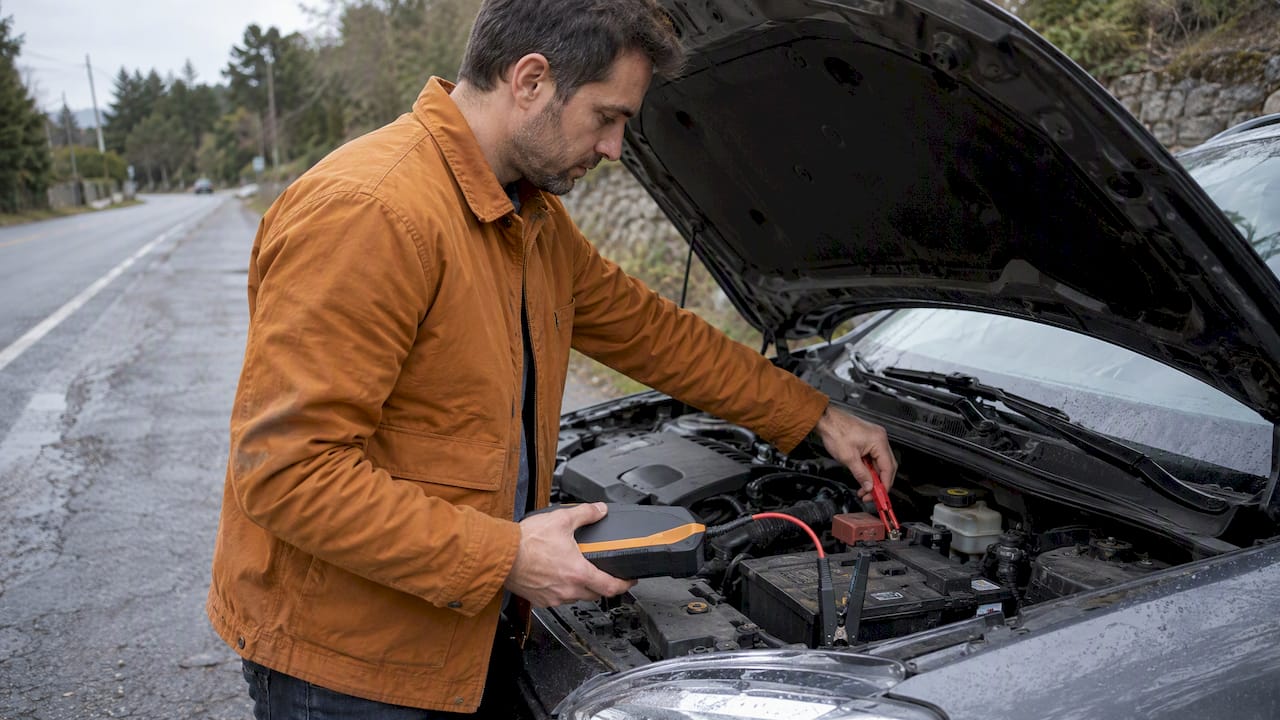
Here’s the honest line I’d draw. A portable jump starter is the right tool when your battery is otherwise healthy and simply drained, a dome light left on overnight, a cold morning, an accessory that ran too long with the engine off. One clean jump, the engine catches, you’re back on the road.

Where I’d push back on the “just jump it” instinct: if you’re reaching for that jump starter more than once every couple of weeks, the problem isn’t amps at all. That’s a battery on its way out, and no amount of cranking amps fixes a battery that can no longer hold a charge overnight. At that point, a load test at a parts store or mechanic tells you more in five minutes than another jump ever will.
The other place I see people get hurt, literally and financially, is rushed connections. Reversed polarity, clamps touching the wrong metal, skipping the ground connection point in the manual. A jump starter with real BMS protection forgives some of that. A bargain unit without it might not, and the repair bill for a fried alternator or computer module dwarfs whatever you saved buying the cheapest option on the shelf.
— Tony
Most jump starters on the market lead with a big peak-amp number and leave you guessing about what actually happens when you clamp on. Sabezon takes the opposite approach: its 4-in-1 jump starter pairs practical cranking capability with a built-in air compressor, a power bank function, and a safety suite designed around real protection, not marketing math.

If you’ve worked through the table above and know roughly what your vehicle needs, the next step is simple. Browse the 4-in-1 car jump starter and check its specs against your engine type and climate before you check out. For the rest of your smart home lineup, from cleaning tools to kitchen gadgets, Sabezon’s full collections page is worth a browse too. Buy once, buy the right amp class, and stop wondering if your trunk kit will actually work when you need it.
Yes, for most passenger vehicles a jump starter rated around 1000 amps or more covers a wide range of needs from compact cars through many V8 engines and SUVs. If it’s a diesel or you’re in severe cold, check the published CA/CCA number rather than relying on the amp figure alone, since manufacturer engine-size compatibility is the more reliable indicator.
A 500 amp jump starter will start most compact cars and mid-size sedans with a healthy battery, since 400 to 600 sustained amps covers standard passenger vehicles. It’s likely undersized for a V8, SUV, or diesel, and it leaves little margin if your battery is weak or the weather is cold.
If that 3000 figure is a peak amp rating, treat it cautiously, since peak amps represent a brief surge rather than sustained cranking power. Check the unit’s actual CA or CCA rating instead. A jump starter with genuine 3000 CCA would comfortably exceed what any passenger vehicle needs, but that spec is rare and usually reserved for peak-only marketing claims.
No, 100 amps is well below what any standard passenger car needs to crank a dead or weak battery. Most passenger vehicles require jump starters delivering roughly 400 to 600 sustained amps. A 100 amp unit is more suited to trickle charging small batteries than jump-starting an engine.
Diesel engines generally need 1,000 to 2,000 amps or more due to their high compression ratios and glow plug systems, especially in cold weather. Always check the jump starter’s CCA rating against your diesel battery’s own CCA spec, which frequently exceeds 1,000 CCA on trucks and larger diesel vehicles.