Cart
0
Complete Your Setup






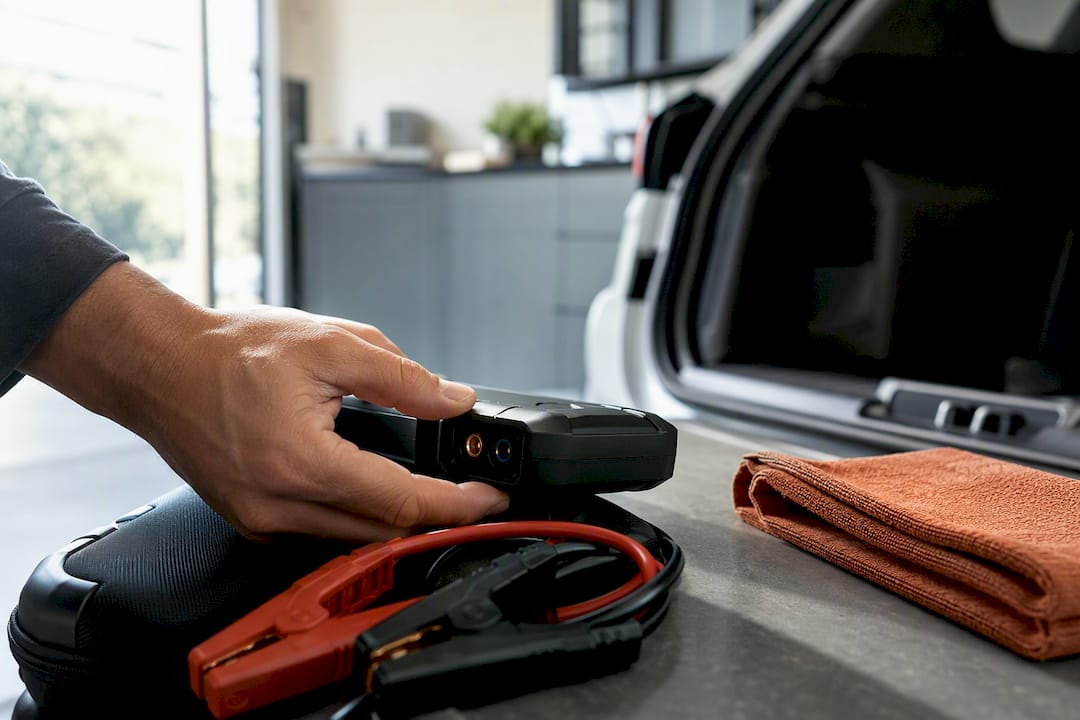
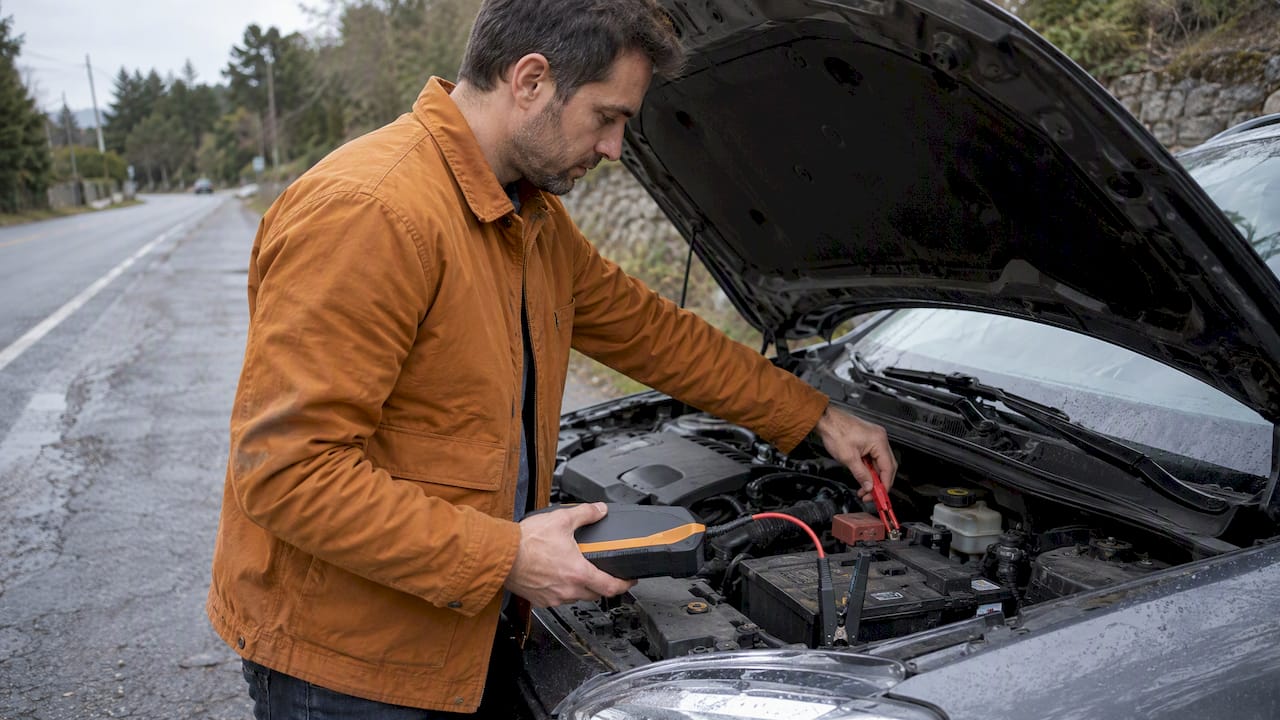
Keep your portable jump starter charged and inspected every 3 months. Store it at roughly 50-80% SOC and out of extreme heat or cold. Recharge it right after every use, never let it sit at zero, and check the clamps and cables for cracks or corrosion at the same time. If the casing looks swollen or the cables feel damaged, stop using it and follow the owner’s manual for safe disposal.
TL;DR:
- Storing your jump starter at 50-80% SOC in moderate temperatures slows capacity loss and prevents accelerated aging caused by full or empty voltage stress.
- Regularly inspecting clamps and cables for corrosion, cracks, or damage is vital, and immediate recharge after use ensures optimal battery health and readiness.
- Keeping the unit in a climate-controlled location like the glovebox extends its lifespan more than storing it in the trunk or under a seat, especially during temperature extremes.
- If the jump starter appears swollen, loses charge quickly, or exhibits physical damage, stop using it and dispose of it safely, avoiding household trash.
- A deep-sleep mode triggered by the BMS is not a sign of failure; a slow recharge often awakens the unit and restores full functionality.
Most portable jump starters run on lithium-ion or LiFePO4 cells, and both age two ways at once: calendar aging (time passing, whether you use the unit or not) and cycle aging (actual charge and discharge events). That’s the first thing to understand about jump starter maintenance. Even a jump starter sitting untouched in your trunk is losing a little capacity every month, just from chemistry doing its thing.
Storing the battery at 50-80% state of charge (SOC) slows that calendar aging considerably compared to storing it full or empty. Full-charge storage keeps the cells under constant high voltage stress, which speeds up degradation. Empty storage is worse in a different way: some technical research on high-temperature calendar aging shows that low SOC thresholds below roughly 20% can actually accelerate capacity fade when combined with heat, since the cell chemistry becomes less stable at both extremes. The 50-80% range is the practical middle ground, and it’s why most maintenance guides converge on the same number.
Temperature is the other half of the equation. Heat accelerates the chemical reactions inside the cell that cause capacity loss, and in worst cases it raises the risk of thermal runaway, a rapid, self-sustaining overheating event. Cold doesn’t damage the cell chemistry the same way, but it does something else important: charging a cold battery too fast can cause lithium metal to plate onto the electrode surface instead of absorbing evenly, a process called dendrite formation. Dendrites can eventually pierce the internal separator and cause a short circuit. That’s why technical safety guidance recommends warming a cold unit to room temperature before plugging it in to charge.
Every quality jump starter has a battery management system (BMS) working behind the scenes. It’s the reason your unit doesn’t explode if you leave the clamps touching or accidentally short the terminals. The BMS also triggers a protective “deep-sleep” mode when the pack sits unused for too long or the charge drops critically low, cutting off power draw to protect the cells. This is normal, not a defect. A unit in deep-sleep often needs a slow “wake” charge before it responds, which is why a dead-seeming jump starter isn’t always dead.
Building a habit around jump starter upkeep doesn’t take long. Set a reminder every 3 months, and you’ll catch problems long before you actually need the unit in an emergency, which is exactly the wrong time to discover it’s dead.
Here’s the routine, in order:
Pro Tip: Do the quarterly check on the same day you rotate your smoke detector batteries or check your tire pressure. Stacking small maintenance habits together makes them far more likely to actually happen.
Storage is where most jump starters quietly die. Nobody kills a jump starter by using it too much. They die from sitting forgotten in a hot trunk at 100% or 0% charge for a year straight.
The target for storage SOC is 50-80%, confirmed across multiple manufacturer and maintenance guides as the sweet spot between safety and longevity. If your unit’s display shows a specific percentage, aim for the middle of that band rather than either edge. If it only shows a rough battery icon, a partial charge (roughly two-thirds full) is close enough.
Temperature swings do more damage over time than most people realize. One technical bulletin on battery-powered tool storage found that extreme vehicle interior temperatures, like a hot trunk or a dashboard baking in direct sun, materially accelerate cell degradation compared to climate-controlled storage. A car trunk in July can exceed 150°F, and that kind of sustained heat shortens lithium battery life dramatically faster than moderate use ever would.
For long-term storage, follow these rules:
If you’re parking a seasonal vehicle, whether that’s a boat, a motorcycle, or an RV, for months at a time, the jump starter shouldn’t stay in it. Owners handling a full seasonal shutdown may find useful overlap with general RV winterization practices, since the same temperature and battery-isolation logic applies to any battery-powered gear left in an unheated vehicle over winter.
One consumer insight worth remembering: storing at 50-80% SOC is a deliberate compromise. It sacrifices a small amount of “peak readiness” in exchange for meaningfully slower chemical aging, which is the trade every manufacturer wants you making.
The glovebox, the trunk, and under the seat all expose your jump starter to different temperature swings, and that difference adds up over a year. The glovebox is usually the best of the three, since it sits closer to the cabin’s climate control and gets less direct thermal soak than the trunk. Under-seat storage is a reasonable second choice, especially in sedans where the trunk runs hotter in summer.
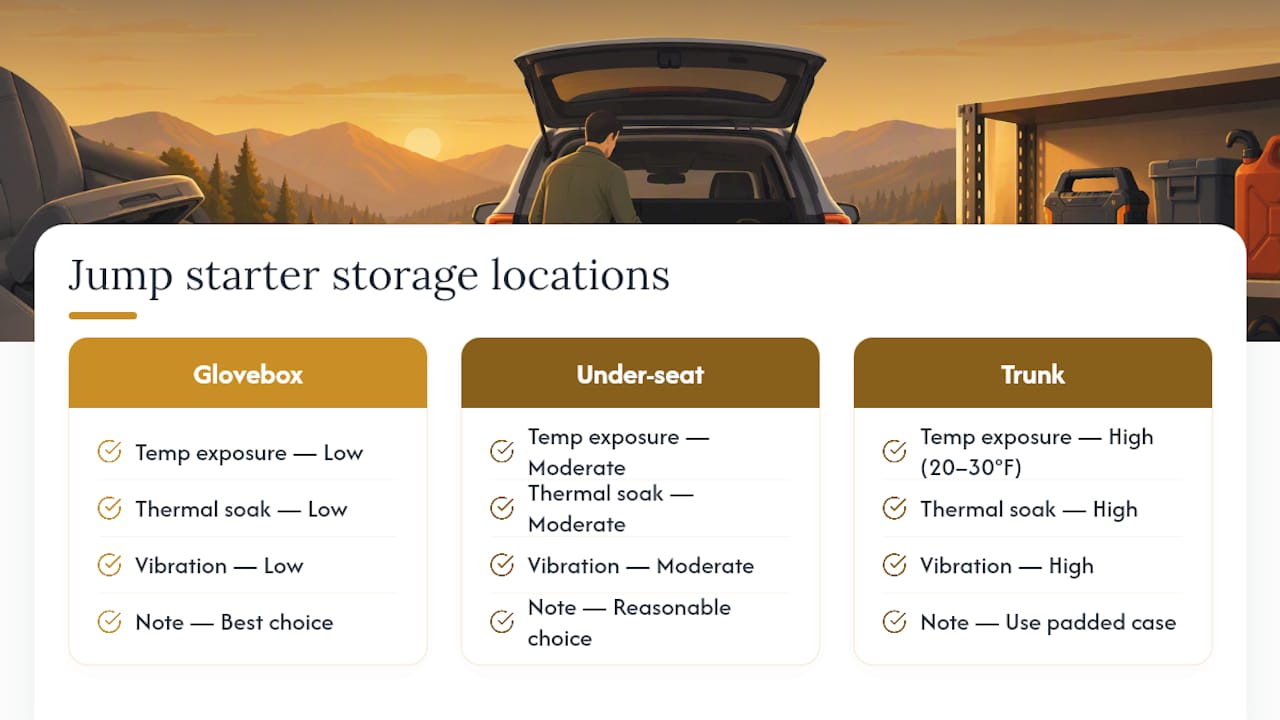
The trunk is the worst option for long-term storage, particularly in a dark-colored vehicle parked outside. Trunk temperatures can run 20 to 30 degrees hotter than the passenger cabin on a sunny day, and that heat has nowhere to go. If the trunk is your only option, at minimum keep the unit wrapped in its original case or a padded bag, which adds a small buffer against both heat transfer and vibration damage from road bumps.
Seasonal adjustments matter just as much as placement. During a heat wave, bring the unit inside overnight rather than leaving it baking in a parked car. During a hard freeze, let a cold unit warm to room temperature before you plug it in, since charging cold cells risks the dendrite formation problem covered earlier.
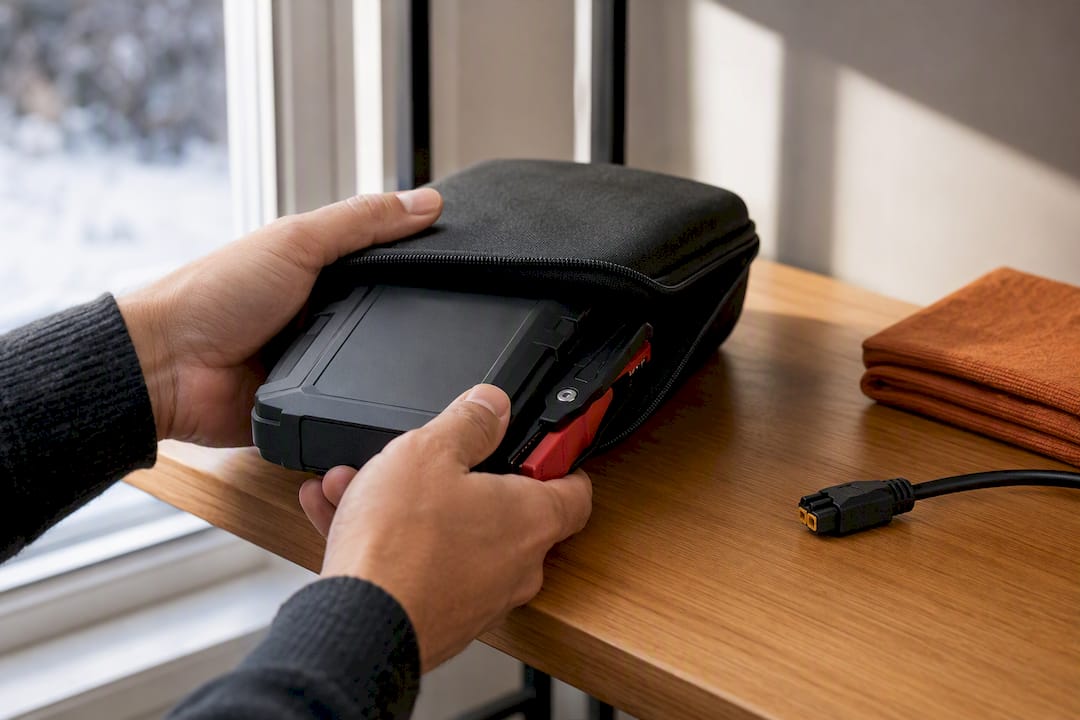
If you manage a fleet vehicle, a seasonal boat, or any vehicle that sits unused for weeks at a stretch, bump the inspection cadence up to quarterly at minimum, and consider checking monthly if the vehicle sits in an unheated garage or an outdoor lot. Sabezon’s guidance on cold-weather jump starter care covers the winter-specific side of this in more detail, including how cold affects peak amp output even when the unit is otherwise healthy.
A jump starter that won’t turn on isn’t necessarily dead. The BMS-triggered deep-sleep mode mentioned earlier is the most common cause of a seemingly unresponsive unit, and it usually has an easy fix.
Try these steps in order before assuming the worst:
Some symptoms point to something more serious than a quick fix. A swollen or misshapen case, a unit that loses charge rapidly even sitting untouched, or clamps that stay hot well after disconnecting all suggest internal cell damage. In those cases, stop using the unit immediately. Don’t attempt to open the casing or continue charging it. Set it aside for safe recycling instead, following the disposal guidance covered in the replacement section below.
Most portable jump starters last somewhere between 3 and 8 years, depending on the battery chemistry, how often it’s used, and how consistently you follow basic maintenance. LiFePO4 units generally outlast standard lithium-ion packs under similar conditions, since that chemistry tolerates more charge cycles before meaningful capacity loss sets in.
A few clear signs mean it’s time to stop relying on the unit:
Don’t throw a failed unit in household trash. Lithium battery devices need dedicated recycling through a battery drop-off point, many auto parts retailers, or a municipal hazardous waste program. Damaged or swollen units especially should never go in regular curbside bins, since punctured lithium cells can ignite.
Here’s what most maintenance articles get wrong: they treat every jump starter failure as a manufacturing defect. In reality, the gap between a unit that dies in year three and one still working in year eight almost always comes down to storage habits, not luck or brand quality.
The pattern is consistent. People buy a jump starter, use it once or twice, then leave it sitting at whatever charge level it happened to have after the last jump, in whatever part of the vehicle had room. That’s the exact combination of variables, wrong SOC and heat exposure, that ages lithium cells fastest. A $40 unit that gets the 3-month check and lives in a temperature-stable spot will often outlast a $150 unit that gets tossed in a hot trunk and forgotten for two years.
The other underestimated factor is how forgiving modern BMS protection actually is, if you let it do its job. Deep-sleep mode isn’t a flaw. It’s the system saving the battery from a full discharge that would otherwise be irreversible. The mistake is panicking and assuming a non-responsive unit is dead, when a 30-minute wake charge would solve it. Understanding that distinction alone probably saves more jump starters from premature “replacement” than any other single piece of advice in this article.
— Tony
Sabezon designed the 4-in-1 Car Jump Starter around the same principle covered throughout this guide: a jump starter is only useful if it’s actually ready when you need it. It combines a battery booster, air compressor, power bank, and tire inflator in one case, with a clear LED display that makes checking charge status part of a quick, easy routine.

If you’d rather not track every maintenance detail on your own, Sabezon’s safety checklist lays out the same 3-month check, 50-80% storage range, and post-use recharge rule in a simple, reusable format. Following it takes just a few minutes each quarter, and it’s a smart, reliable way to make sure your jump starter is ready the one time you actually need it. For readers building out a broader home tech setup, Sabezon’s Smart Home Tech collection covers other practical, easy-to-use gadgets built with the same simple-setup philosophy. Check the jump starter’s product page now for full specs, included accessories, and warranty details before your next trip.
Most portable jump starters last 3 to 8 years, with the range depending heavily on battery chemistry and how well the unit is stored between uses. LiFePO4 packs generally last longer than standard lithium-ion under similar care, and units stored at 50-80% SOC in moderate temperatures consistently outlast ones left at full or empty charge in hot vehicles.
A single full charge typically delivers 10 to 20 jump-starts, depending on the unit’s capacity and the size of the vehicle’s engine. Over its full lifespan, a well-maintained jump starter can be recharged and used hundreds of times before capacity fade makes it unreliable.
No. Leaving a jump starter on a charger constantly keeps the cells at a sustained high voltage, which accelerates calendar aging over time. Charge it to roughly 80%, unplug it, and recheck the level every 3 to 6 months instead of leaving it connected indefinitely.
A properly used jump starter, connected in the correct clamp order with the negative clamp grounded away from the battery, doesn’t damage a healthy vehicle battery. Most modern units include reverse-polarity protection specifically to prevent this kind of damage during a jump-start.
The full routine, including clamp inspection and cleaning steps, is outlined in Sabezon’s jump starter safety checklist.