Cart
0
Complete Your Setup



If your plant’s soil is wet and the leaves look droopy or yellow, stop watering right now. Waterlogged roots lose access to oxygen, and that’s what triggers rot, not a lack of care. Before you add another drop, check root-zone moisture with a finger or dowel test, and make sure the pot actually drains. Getting those two habits right is how you prevent overwatering houseplants for good.
TL;DR:
- Overwatering signs include yellowing inner leaves, mushy stems, standing water, and foul odors, which together confirm excess moisture damage.
- Proper soil and container setup are essential, with drainage holes and a well-draining mix preventing chronic overwatering issues.
- Regular moisture checks at root depth using finger, dowel, or weight tests are more reliable than surface observation before watering.
- In mild cases, stopping watering and improving airflow can recover plants in a few days, but severe rot requires root trimming and fresh soil.
- Self-watering planters suit moisture-loving plants but can cause overwatering if used with species that prefer dry soil, so choose containers based on plant needs.
Overwatering rarely announces itself with one obvious symptom. It shows up as a pattern: yellowing that starts on the lower or inner leaves, stems that feel soft or mushy instead of firm, and soil that stays wet for days after you last watered. A plant that’s drought stressed wilts because it’s dry and brittle. A plant that’s overwatered wilts because its roots are damaged and can’t pull up water even though the soil is soaked. That distinction is why Clemson’s Home & Garden Information Center points out that adding more water to a wilted, waterlogged plant only makes things worse. The fix isn’t more water. It’s less, plus a root check.
Look for these signals together, not in isolation:
One symptom alone could mean low light or a nutrient issue. Two or three together, especially with a musty smell, point straight to excess moisture.
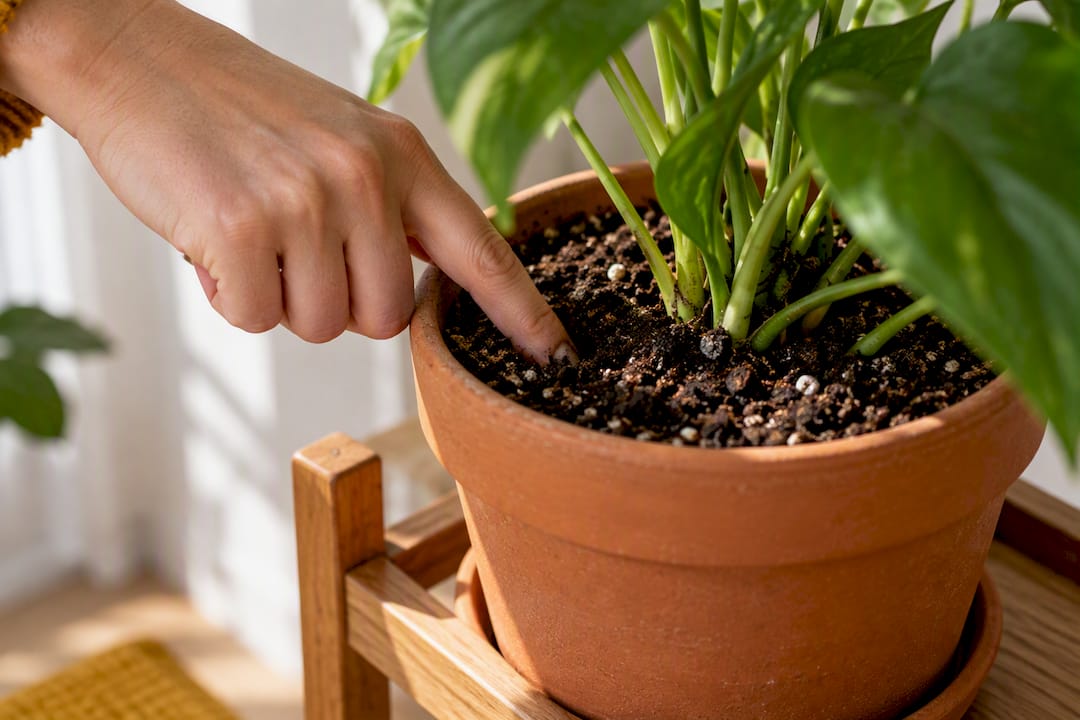
Guessing by looking at the surface is the single biggest reason houseplant owners overwater. The top layer of soil dries fast, even when the root zone underneath is still soaked, so a quick glance tells you almost nothing useful. University of Maryland Extension recommends testing the actual root zone before you water again, not the calendar and not the surface.
Here’s the routine, in order of how often you’ll use each one:
Pro Tip: Keep one wooden skewer near your biggest, deepest pot. It’s the cheapest, most reliable way to check moisture on plants where your finger just can’t reach root depth.
The fix depends on how far things have gone, so start with the least invasive step and only escalate if the plant doesn’t respond.
Mild overwatering (soil is wet but the plant looks mostly okay):
Severe overwatering (mushy stems, rotten smell, collapsing leaves):
Root rot organisms thrive in soil that stays wet too long, and once they take hold, waiting it out isn’t enough. Wisconsin Horticulture recommends pulling the plant from its pot, rinsing the roots gently, and inspecting them closely. Firm, white or tan roots are healthy. Soft, dark, or slimy roots need to go.
For plants that are salvageable but slow to dry, a little extra warmth and airflow speeds recovery. Better Homes & Gardens suggests increasing light and air circulation moderately rather than blasting a fan directly on a stressed plant, which can add stress on top of stress.
Fixing a soggy plant once is manageable. Fixing the same plant every other month means the setup is the problem, not your watering habit. Three things matter most: the pot, the mix, and the technique.
Pots and containers. Any pot you use needs a functional drainage hole, full stop. If you love a decorative pot without one, use it as a cachepot and keep the actual plant in a nursery pot with drainage inside it, then pour out any water that collects after each watering. NC State Extension notes that the old trick of adding gravel to the bottom of a pot usually doesn’t help drainage at all. It just raises the water table inside the pot and can make things worse. Terracotta is a smart pick for plants that like to dry out between waterings, since the porous walls wick away extra moisture, though moisture-loving species like African violets often do better in plastic or glazed pots.
Potting mix. A dense, water-retentive mix is often the real culprit behind chronic overwatering, not your watering hand. A blend of roughly equal parts coir or peat and perlite drains well for most tropical houseplants, while heavy feeders or thick-rooted plants may want an even chunkier mix with added bark or pumice.
Technique. Water thoroughly until it runs from the drainage holes, then leave the plant alone until the root zone dries out again. That’s a different habit than “a little water every few days,” which keeps the mix perpetually damp and starves roots of oxygen.
Pro Tip: If a pot feels heavy days after watering, the mix is probably too dense. Repotting into a chunkier blend fixes more chronic overwatering problems than adjusting your schedule ever will.
The best watering habit isn’t a calendar. It’s a five-minute weekly check that takes the guesswork out of the process.
This routine replaces “water every Sunday” with something that responds to what the plant is actually doing.
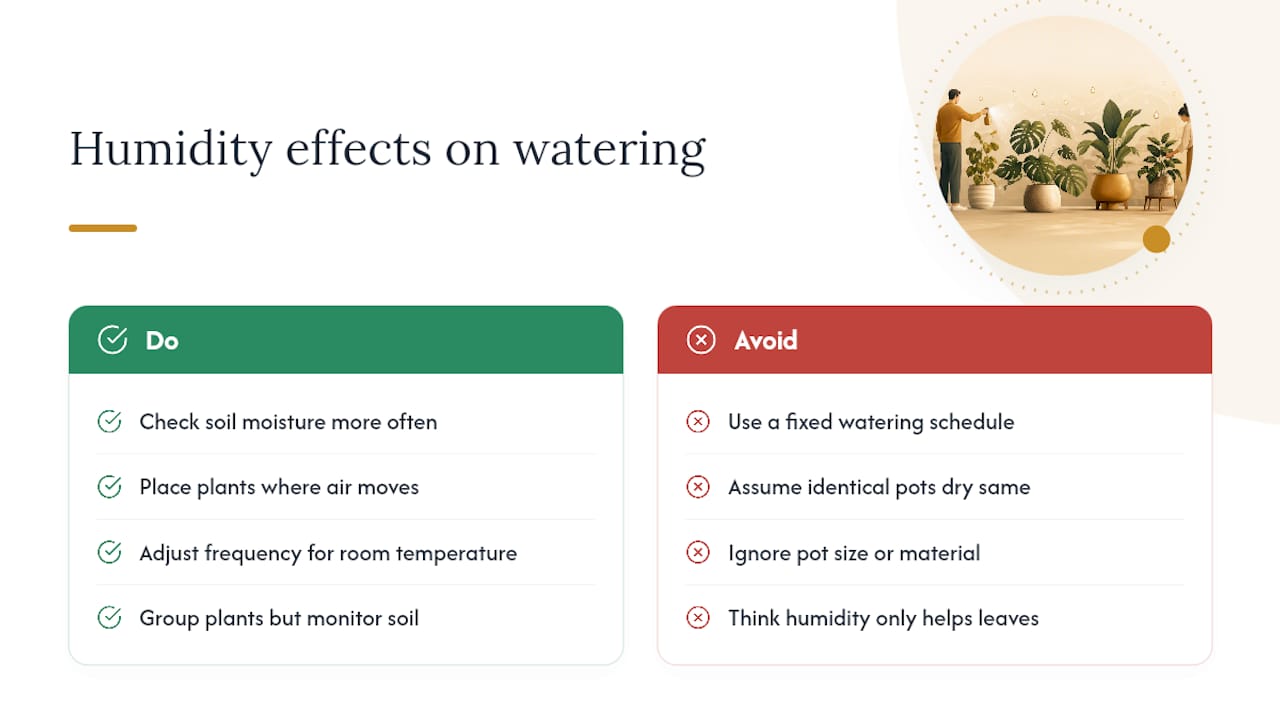
Humidity changes how fast soil dries, which means it changes your entire watering routine even if you never touch the watering can differently. In a dry apartment with forced-air heat running all winter, potting mix can dry out in half the time it takes during a humid summer stretch, even in the same pot with the same plant.
Air circulation matters just as much as ambient humidity. A plant tucked into a low-airflow corner holds moisture at the soil surface far longer than one sitting near an open window or a gently moving ceiling fan. That’s part of why two identical plants in the same room can dry out at completely different rates depending on where they sit.
Temperature plays a role too. Warmer rooms speed up evaporation and the plant’s own water use, while cooler rooms, especially in winter, slow both down. That’s one reason Clemson’s Home & Garden Information Center is firm on the point that there’s no universal watering interval. Frequency depends on species, pot size and material, potting mix, location in your home, and season, all working together.
Grouping plants for humidity is popular, but it cuts both ways. A pebble tray or a cluster of plants raises local humidity around the leaves, which can slow soil drying at the same time. If you group plants this way, check moisture more often rather than less, since the humidity boost you wanted for the leaves can quietly work against the roots.
Plant care advice tends to swing between two extremes: pure discipline or pure gadgetry. Neither one is the full answer. A finger test costs nothing and works for almost every houseplant, so master that first. But once you’ve got a dozen plants and a busy week, the right container does real work for you.
A self-watering planter with a well-draining soil blend reduces how often you’re rescuing a plant from either extreme, wet or forgotten-dry. The catch is matching the system to the plant. Steady-moisture lovers like peace lilies or ferns thrive in reservoir setups; succulents and cacti do not, since Clemson’s guidance is clear that self-watering systems suit species that want consistent moisture, not ones built to dry out completely between drinks.
— Tony
Good habits solve most overwatering problems, but the right pot removes a lot of the daily guesswork on its own. An alternative to constant manual monitoring for plant owners who travel, work long hours, or just want fewer soggy-soil surprises is a well-matched planter and soil setup that keeps moisture-loving plants steady without daily checking.

The Verdara™ Self-Watering Planter is built for plants that want consistent moisture, like pothos, peace lilies, and ferns, not for succulents or cacti that need to dry out fully between waterings. Pair it with a coir-and-perlite soil blend for the right drainage balance, and check our planter sizing guide before you buy so the reservoir matches your pot and plant size. If you’d rather browse the full lineup first, the Sabezon collections page is the place to start.
This guide leans on university extension research, not general blog advice, for its diagnosis and rescue steps:
Check root-zone moisture before every watering instead of following a fixed schedule, using a finger or dowel test about 1 to 2 inches deep. Pair that habit with a pot that has real drainage holes and a well-draining mix, and empty saucers right after you water.
Mild cases recover well once you stop watering, empty the saucer, and let the soil dry out fully, usually within a week. Severe cases with mushy roots need trimming and a repot into fresh mix, and Wisconsin Horticulture notes that plants with extensive root rot sometimes can’t be saved.
There’s no single interval that works for every plant, since frequency depends on species, pot size, potting mix, light, and season, as Clemson HGIC explains. Checking root-zone moisture before each watering is far more reliable than watering on a set day.
Mild overwatering often resolves in 3 to 5 days once you stop watering and improve airflow around the pot. Plants with root rot take longer, since they need trimming and repotting first, and full recovery can take several weeks as new roots grow in.
They can, if you use one for a species that wants to dry out between waterings, like a succulent or cactus. A self-watering planter works best for moisture-loving plants such as ferns and peace lilies, where steady dampness matches what the roots actually want.