Cart
0
Complete Your Setup


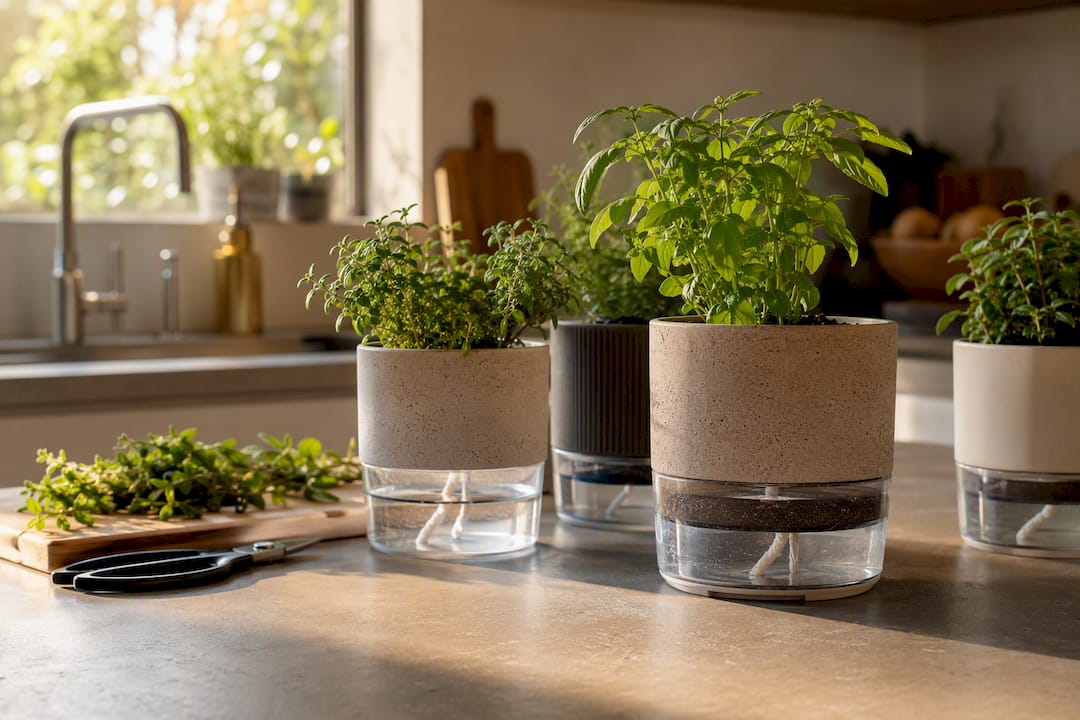
Herbs and small succulents grow best in small self-watering planters, about 4 to 6 inches wide. Most houseplants, like pothos and snake plant, do well in medium planters at 6 to 12 inches. Large vines, palms, and vegetables like tomatoes need large to extra-large planters, 13 inches and up. That’s the short answer.
Refill schedules follow the same logic. Small herb planters usually need topping off every 1 to 2 weeks. Medium houseplant setups can run 2 to 3 weeks between refills. Large vegetable planters in full sun might need water every few days during peak summer growth.
If you’re shopping for a kitchen herb garden or a compact plant on a countertop, the Verdara™ Self-Watering Planter from Sabezon is built for exactly that small-to-medium range, with a reservoir and wick system already sized correctly so you’re not guessing.
Choosing the correct self-watering planter size comes down to matching container depth and reservoir ratio to your plant’s actual root system, not its final leaf size.
| Point | Details |
|---|---|
| Match size to roots | Small (4–6 in) fits herbs and succulents; medium (6–12 in) fits most houseplants. |
| Keep the 1:3 ratio | Size the reservoir to 25–33% of soil volume to avoid stagnant, oxygen-poor water. |
| Measure before buying | Add 1–2 inches to your current pot’s diameter, or jump a full size band for fast growers. |
| Adjust for light and climate | Sun-loving, fast-growing, or outdoor plants need larger sizes and more frequent refills. |
| Start compact with Verdara™ | Sabezon’s Verdara™ Self-Watering Planter fits the small-to-medium band for herbs and countertop plants. |
Picking the right self-watering planter size starts with knowing the four practical bands nurseries and extension offices actually use. These aren’t arbitrary. They track root depth, which is the real driver of plant health, not the planter’s looks.
Shallow-rooted herbs and small houseplants need noticeably less depth than vegetables, which generally do better with 8 to 12 inches of soil depth according to University of Georgia Extension guidance. That single rule explains why a basil plant thrives in a 4-inch pot while a tomato sulks in the same container.
Width matters as much as depth once a plant gets top-heavy. A tall pothos vine or a young fiddle leaf fig needs a wider base for stability, not just more soil. A narrow, deep pot might hold enough dirt but tip over the first time a breeze hits it on a balcony.
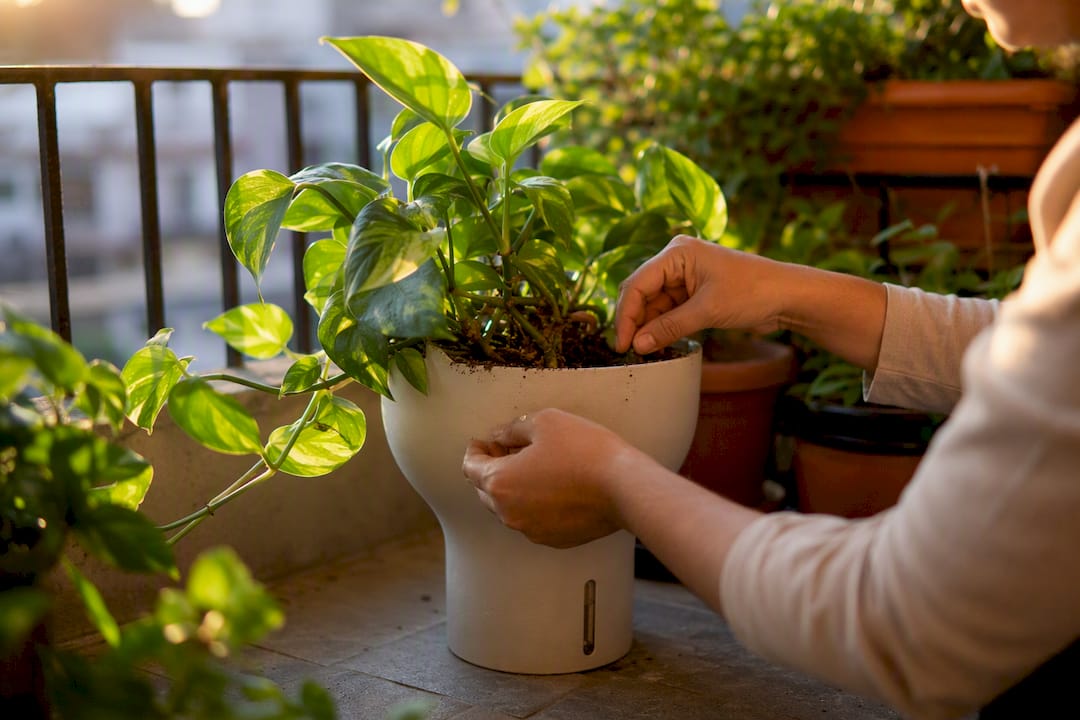
Pro Tip: If a plant’s foliage spread is wider than its current pot, size up even if the roots look fine. Top-heavy plants topple, and self-watering reservoirs at the base only add weight low down, which helps, but won’t fix a pot that’s too narrow for the crown.
The planter’s outer size only tells half the story. What happens underneath, in the reservoir, determines whether your plant thrives or drowns.
Go much higher than that and water sits stagnant long enough to starve roots of oxygen, creating the kind of anaerobic conditions that invite root rot. Go lower and you lose the whole point of a self-watering system, since you’ll be refilling constantly.
Wick placement is the other half of the equation. A wick should reach roughly one-third of the way into the soil column. For medium vegetable planters, 2 to 4 inches of wick depth is a reliable starting point, stretching to 4 to 6 inches for deeper containers.
Signs your reservoir is too generous for your planter size:
Fixing oversaturation is usually simpler than people expect. Reducing wick diameter or trimming its height solves most overwatering complaints faster than switching your entire soil mix, since the wick is the actual valve controlling moisture flow.
You don’t need a fancy formula to get this right. Grab a tape measure and follow these steps.
For genuinely large vegetables, a DIY two-bucket system using two 5-gallon food-grade buckets often beats buying an oversized commercial planter, since you control the reservoir volume directly.
Where a plant lives changes the math on planter size as much as the plant species does.
Refill cadence tracks these same variables. A small herb setup indoors might go 2 to 3 weeks between refills in moderate conditions, while a large tomato planter in full summer sun can need water every 3 to 5 days.
University extension programs have studied container gardening for decades, and their guidance holds up better than most seasonal gardening advice you’ll find online.
Matching container depth to root type and using sub-irrigation to cut water waste isn’t a trend. It’s the same principle extension offices have taught home gardeners for years, just applied to a modern planter design.
That extension research is exactly why the 1:3 reservoir rule and the 2 to 4 inch wick guidance work as well as they do. They’re not marketing numbers. They’re a practical translation of root-zone science into something you can measure with a tape measure. Sabezon built the Verdara™ Self-Watering Planter around these same proportions, sized for the herb and small houseplant range most kitchen gardeners actually need.
The 1:3 reservoir-to-soil ratio isn’t a hard ceiling, it’s a starting point you adjust based on what you’re growing. A leafy vegetable that drinks constantly can push toward the 33% upper end without issue.
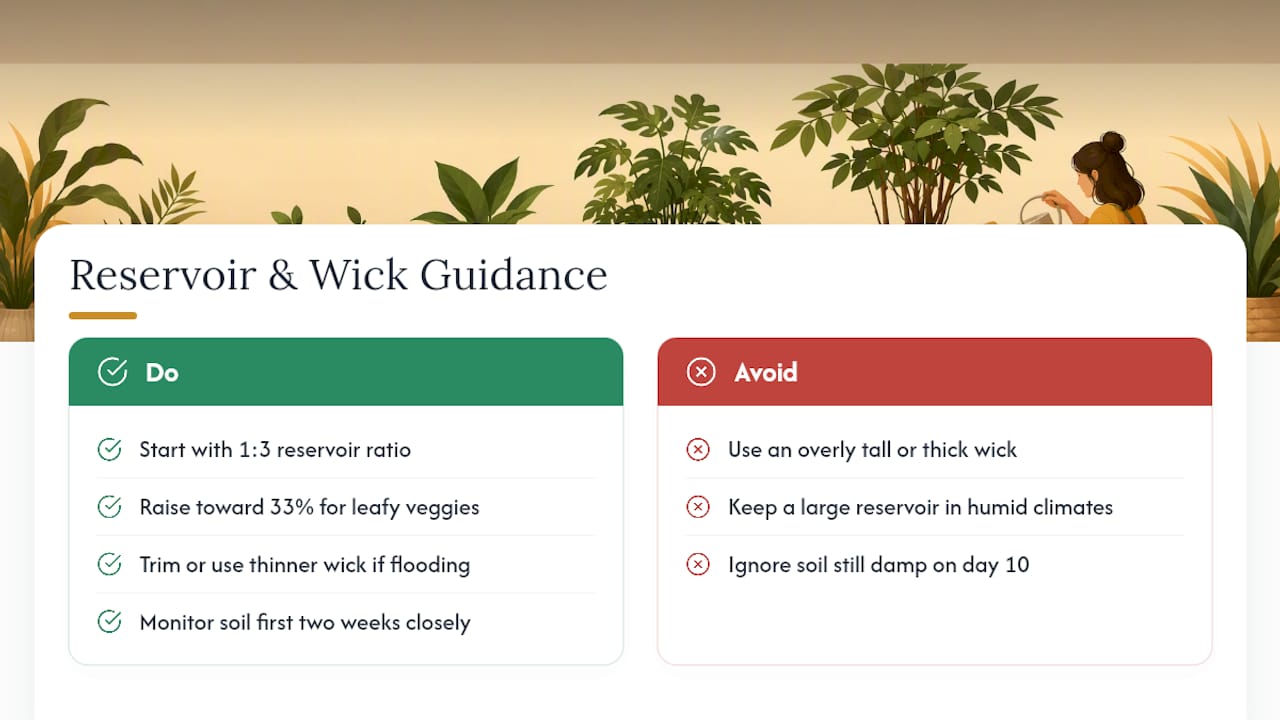
Wick height needs the same kind of fine-tuning. A wick that’s too short leaves the top layer of soil dry even with a full reservoir, since capillary action can only pull water so far. A wick that’s too tall or too thick floods the root zone and keeps soil perpetually damp. The fix is almost always mechanical: trim the wick, swap to a thinner cotton or felt strip, or adjust how deep it sits.
Climate plays a role too. In humid regions, soil holds moisture longer, so a slightly smaller reservoir ratio prevents the waterlogged conditions that invite fungus gnats and root rot. Watch the first two weeks after any resize or ratio change closely. Soil that’s still damp on day 10 tells you to scale the wick back before you scale up the reservoir again.
Material choice becomes a real engineering question once you cross into the large and extra-large size bands. A small 4-inch ceramic herb pot weighs almost nothing even when saturated. A 24-inch resin planter filled with wet soil and a full reservoir can weigh 40 pounds or more, and that changes what you should buy.
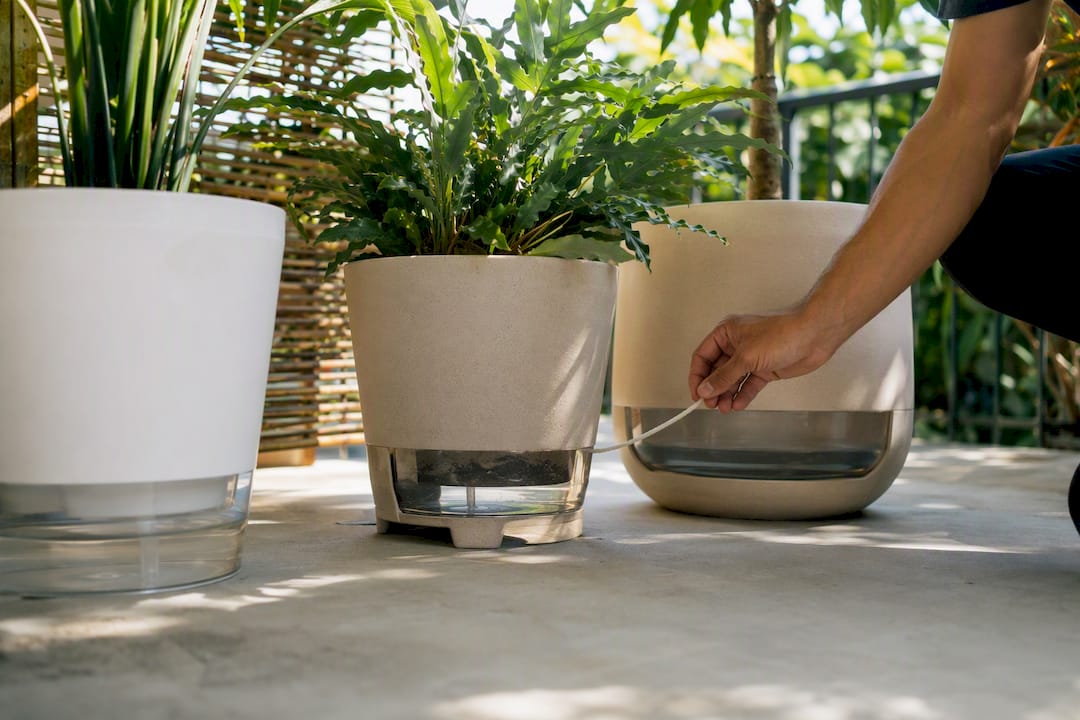
Plastic and resin dominate the small and medium bands because they’re light, insulate roots from temperature swings, and don’t crack in freezing weather the way terra cotta does. They also hold self-watering reservoirs well, since the material seals tight around wick channels.
Ceramic and stoneware look great on a windowsill but add real weight fast, and porous versions can leak reservoir water through the walls over time, defeating the entire self-watering design.
Fiberglass and lightweight composite materials show up in the large and extra-large bands specifically because they hold structural strength without the dead weight of stoneware. If you’re planning to move a large planter seasonally, or you live somewhere with a balcony weight limit, this category matters more than color or finish.
For anything above the medium band, check the manufacturer’s filled weight, not just the empty planter weight, before you commit to a spot.
Undersized planters cause more plant problems than gardeners realize. When roots hit the wall of a too-small container, they start circling, a condition called being root-bound. Once that happens, the plant stops absorbing nutrients efficiently even if you water and feed it perfectly, because the roots simply have nowhere productive left to grow.
Oversized planters cause a quieter, less obvious problem. Too much soil around a small root ball holds excess moisture the roots aren’t using, and that moisture sits in a self-watering reservoir with nowhere to go. This is the same anaerobic risk mentioned earlier with reservoir ratios, except now it’s driven by planter size rather than water volume.
The sweet spot is a planter that gives roots room to expand for one full growing season without drowning them in unused soil. That’s the real reason the size bands in this guide track plant type so closely. A snake plant’s slow, compact root system needs the medium band. A monstera’s aggressive, spreading roots justify moving to large well before the plant looks cramped, because by the time you see stress in the leaves, the roots have usually been struggling for weeks.
Once you own one self-watering planter that works, the temptation is to just buy more of the same size. Resist that instinct and think in terms of plant groups instead.
Group plants with similar water needs into the same size band so your refill schedule stays predictable across your whole collection. Mixing a thirsty tomato and a drought-tolerant succulent in identical planters means one of them is always wrong.
For a kitchen herb wall or a windowsill collection, several small planters in the 4 to 6 inch range are more practical than one large divided container, since each herb can dry out or stay moist at its own pace without affecting its neighbor. For a patio vegetable garden, standardize on one or two large sizes rather than a mismatched set, so you’re not tracking five different refill schedules.
If you’re scaling toward a dozen or more planters, batch your reservoir refills on a single day each week rather than watering reactively. It turns plant care into a five-minute routine instead of a daily interruption. A small-space container gardening approach that groups plants by light and water needs, rather than by looks, tends to scale the most cleanly as a collection grows.
Most planter size advice treats dimensions as a cosmetic choice, matching a pot to a room’s decor instead of a plant’s root system. That’s backwards, and it’s why so many self-watering planters underperform even when the reservoir technology itself is sound.
The extension research behind this guide points to a simpler priority order: root depth first, reservoir ratio second, aesthetics last. A gorgeous oversized planter with the wrong wick height will drown a plant just as reliably as a neglected pot that never gets watered at all. Overcorrecting on size, buying extra-large “to be safe,” causes more root problems than buying slightly too small and repotting a season later.
If there’s one thing worth prioritizing above everything else in this guide, it’s measuring your actual root ball or nursery pot before you shop, not eyeballing it. The 1 to 2 inch sizing rule and the 1:3 reservoir ratio only work when you start from a real number. Skip that step and every other calculation in this article becomes a guess dressed up as a formula.
If you’ve done the measuring and landed in the small-to-medium range, the small size (4 to 6 inches) fits single herbs and succulents, while the medium size (6 to 12 inches) handles a pothos, peace lily, or a small tomato start. Sabezon’s Verdara™ Self-Watering Planter is built around those exact bands, with a reservoir and wick already tuned to the 1:3 ratio this guide walks through, so you skip the trial-and-error most first-time buyers go through.
That means no calculating soil volume by hand, no trimming a wick to stop soggy roots, and no guessing whether your countertop herb garden needs refilling twice a week or twice a month. The planter’s design already answers those questions for compact indoor setups. If your kitchen herb collection or houseplant shelf falls into that small-to-medium size band, this is a straightforward, ready-to-use fit rather than a project.
For herb-specific setups, Sabezon’s guide to self-watering planters for herbs walks through placement and care details worth reading alongside the product page. Browse the Verdara™ planter directly, or check the full Sabezon smart home lineup to see what else fits your kitchen setup.