Cart
0
Complete Your Setup


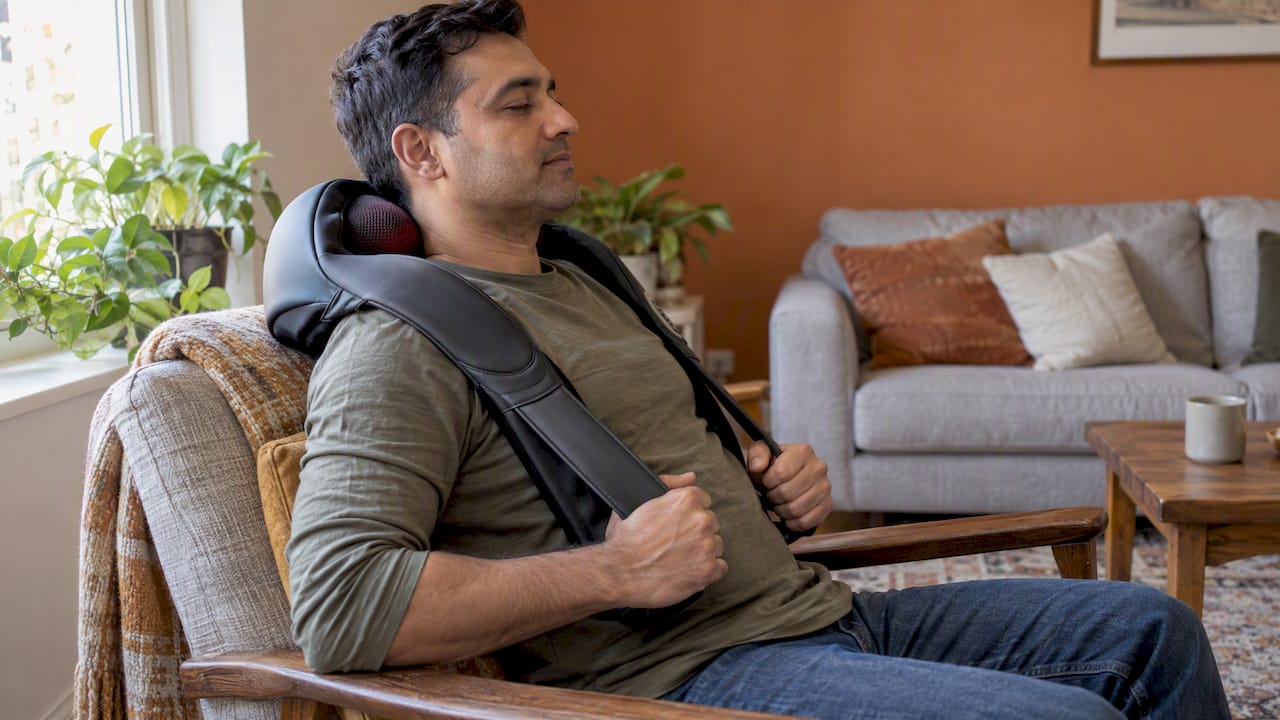
A neck massager can ease tightness, help you unwind after a long day at a desk, and make a simple self-care habit easy to keep. What it cannot do is cure neck pain or headaches. The research on massage is mixed, and most of the relief it shows is short-term. Here is what is supported, what is not, and how to use one safely.
For most healthy adults with ordinary desk-day tightness, yes, in a limited way. Warmth, kneading and gentle pressure relax tight muscles and feel good. That feeling is real, and for many people it is the main reason to own one.
The caveat is what the research actually measured. Almost all of it looks at massage given by a trained person, not at home devices. So we read it as a guide to what massage in general can do, and not as proof for any single product.
The U.S. National Center for Complementary and Integrative Health (NCCIH) says massage therapy may help neck or shoulder pain, but its effectiveness for neck pain remains uncertain. It also notes the benefits may be short-lived. That is a fair expectation to carry into any purchase: relief now, not a permanent fix.
A stiff neck often triggers a protective muscle spasm. Cleveland Clinic chiropractor Dr. Andrew Bang says finding relief takes some trial and error until you find a comfortable sweet spot, and that massage should always be gentle and communicative. In plain terms, you should be able to feel what is working and back off when it is not.
The good feeling is not proof of lasting benefit. It tells you the muscles are less tense for now. It does not tell you the cause of the tightness has gone, which is often posture, long hours at a screen, or poor sleep.
Here is the evidence in order of how much weight we give it.
NCCIH’s summary of a 2016 review of four U.S. studies with 519 people found short-term neck-pain relief when massage sessions were long and frequent enough. The words that matter there are “short-term” and “long and frequent enough.” A single quick pass will not do much, and the benefit does not stick around without repeating it.
A randomized U.S. trial points the same way. In it, 64 adults with chronic neck pain received up to 10 massages over 10 weeks. At 10 weeks, meaningful improvement in disability occurred in 39% of the massage group versus 14% of a self-care-book group, and symptom improvement in 55% versus 25%. By 26 weeks, the groups no longer differed.

A 2024 Cochrane review of 33 studies on massage for subacute and chronic neck pain found that massage compared with “dummy” massage probably makes little to no difference in pain, function or quality of life at 12 weeks. The authors called for larger, well-designed trials with adequate dosing.
Cochrane’s own summary explains why the picture is uncertain. Most of the evidence is low certainty, with small trials and participants who knew what treatment they received. That does not mean massage does nothing. It means the research cannot yet say how much of the effect is the massage and how much is the comfort of being cared for.
| Benefit | How well supported | Our plain-language take |
|---|---|---|
| Short-term relief of neck tension | Some support, mostly short-term | A reasonable thing to expect |
| Relaxation and stress relief | It feels good, but the research focus is pain | A common, realistic reason to use one |
| Long-term pain reduction | Uncertain, no clear difference by 12 to 26 weeks in the studies above | Do not count on it |
| Headache relief | Limited and inconsistent | Comfort at most, see the next section |
| Better posture | Not shown by the sources we reviewed | Pair it with movement and workstation changes |
We left out the bigger claims you may see on product pages, such as boosted immunity or healing. We found nothing in the sources above to support them, so we do not repeat them.
Maybe a little, for tension-type tightness, but the evidence is thin. NCCIH says massage research for headaches is limited and inconsistent. Limited evidence from two small studies suggests it may help migraines, but clear conclusions cannot be drawn.
That leaves a practical approach. If your headache comes with a tight neck and shoulders after a long day, a gentle session may take the edge off. If headaches are frequent, severe, or new for you, a massager is not the answer. Get them assessed.

Short sessions win. Verywell Health’s guidance, drawn from physical-therapy and rehabilitation specialists, is to limit a neck-massager session to about 20 minutes, since too much pressure or time can irritate tissues and cause more symptoms.
Our advice for a first week:
Mild soreness afterward can happen. Cochrane lists mild treatment soreness as a minor temporary effect of massage. Soreness that lingers or grows is a sign to cut back. For a fuller walkthrough, see our guide to neck massager safety for home users.
The back of the neck and the muscles across the top of the shoulders are the usual targets for a home massager. The front and sides are different.
As for the popular question about muscle knots popping: the sources we reviewed do not address it, so we will not promise it. A knot that eases under steady, gentle pressure is fine. Forcing it with hard pressure is not.
NCCIH says harmful effects from massage appear uncommon. It also says rare serious effects, including blood clots, nerve injury or bone fracture, have been reported, particularly with vigorous massage or in people at higher risk of injury.
Cleveland Clinic goes further on one risk. It warns that deep tissue neck massage and neck manipulation are risk factors for vertebral artery dissection, which can lead to stroke. It lists Ehlers-Danlos syndrome, Marfan syndrome and fibromuscular dysplasia among conditions linked to a higher risk.
So talk to your doctor before using a neck massager if any of these apply:
A massager is for ordinary tightness. Some symptoms need a clinician instead. Mayo Clinic says to see a healthcare professional if neck pain worsens despite self-care, persists for several weeks, radiates down the arms or legs, or comes with headache, weakness, numbness or tingling. It advises emergency care for severe neck pain after a traumatic injury, or with muscle weakness or high fever.
If headaches and neck pain keep showing up together, a hands-on assessment of the spine and nerves can sort out the cause. Options include a physician, a physical therapist, or chiropractic care for headaches. Use a massager for comfort in the meantime, not as a substitute.
The research gives a hint about how to make home use count: dose and frequency matter. The studies that found benefit used repeated sessions over weeks, not one-off use. A few habits help:
We sell home gadgets, so you might expect us to oversell. We would rather you buy one knowing exactly what it does.
We think a neck massager earns its place for one reason: it makes a relaxing, low-effort habit easy. Most of our customers are busy people who sit a lot and want a few minutes of relief at the end of the day. That is a fair use. It is also why we focus on simple setup, clear controls and short sessions. A device that is intuitive is a device you use gently and consistently.
We do not claim a massager treats headaches, fixes posture or replaces medical care. The evidence above does not support that, and we do not want you counting on it. If something feels off, stop and see a professional.
Our rule of thumb: start short, keep it gentle, stay on the back of the neck and shoulders, and know your warning signs.
— Tony
If you want an easy-to-use option for short sessions at home, take a look at the TermaSage™ Neck & Shoulder Massager. It is built for the back of the neck and shoulders, where home use is best suited.

You can also browse the rest of our smart home tech collection for practical gadgets that save time around the house. Smart Products. Zero Hassle.
For most healthy adults, a gentle neck massager is a reasonable way to ease tightness and relax for a few minutes. The benefit is usually short-term, and research on massage for neck pain is still uncertain. People with artery, connective-tissue or recent neck problems should ask a doctor first.
It may take the edge off a tension headache that comes with a tight neck, but the research on massage for headaches is limited and inconsistent. If your headaches are frequent, severe or come with numbness, weakness or tingling, get them assessed rather than relying on a massager.
Keep sessions to about 20 minutes at most, and start with 5 to 10 minutes if the device is new to you. Follow the maker’s instructions. Stop right away if you feel sharp pain, tingling or dizziness.
Avoid the throat, the spine and the sides of the neck, and never press on the carotid area near the windpipe. Stay on the muscles at the back of the neck and the tops of the shoulders, with light pressure.