Cart
0
Complete Your Setup


Yes, smart meat thermometers are accurate enough for both safety and precision cooking. Premium models publish accuracy specs of ±0.5°F to ±1.0°F, well inside the USDA’s ±2°F safety margin. The hardware isn’t usually the problem. Placement, timing, and ambient-sensor limits cause almost every “wrong” reading. Run a quick ice-bath check, follow the placement checklist below, and your readings will match what the spec sheet promises.
TL;DR:
- Proper probe placement away from bone and fat is crucial for accurate readings, especially on thin cuts where small placement errors can cause significant inaccuracies.
- Testing your probe with an ice bath and boiling water can confirm whether your thermometer stays within a 1 to 2°F offset, helping you avoid misreads during cooking.
- Wireless probes’ ambient sensors near cold meat can give misleading temperature readings, so using a separate wired ambient probe provides more reliable environment tracking.
- Low batteries can slow response times and cause connection issues, which may result in incorrect or lagging readings, making regular charging or battery replacement essential.
- Using both instant-read thermometers for quick checks and wireless probes for long cooks offers the best accuracy and convenience for different grilling situations.
An accuracy spec like “±0.5°F” tells you how far a probe’s reading can drift from a true reference temperature under controlled lab conditions, not necessarily in your smoker at 6 PM with the lid opening every ten minutes. Manufacturers test these numbers in stable water baths. Your grill adds wind, opening lids, and grease. That gap between lab conditions and dinner conditions is where most of the frustration lives.
Two sensor technologies drive these specs. Thermocouples respond in one to two seconds and show up in professional instant-read units. Thermistors, sometimes called NTC sensors, respond a bit slower but cost less to manufacture, which is why most wireless leave-in probes use them. Neither is inherently better for home cooking. What matters more is how many sensors sit inside the probe.
Multi-sensor probes place several sensors along the shaft instead of just one at the tip. That design finds the meat’s actual thermal center automatically, so you don’t have to guess whether you hit the exact right depth.
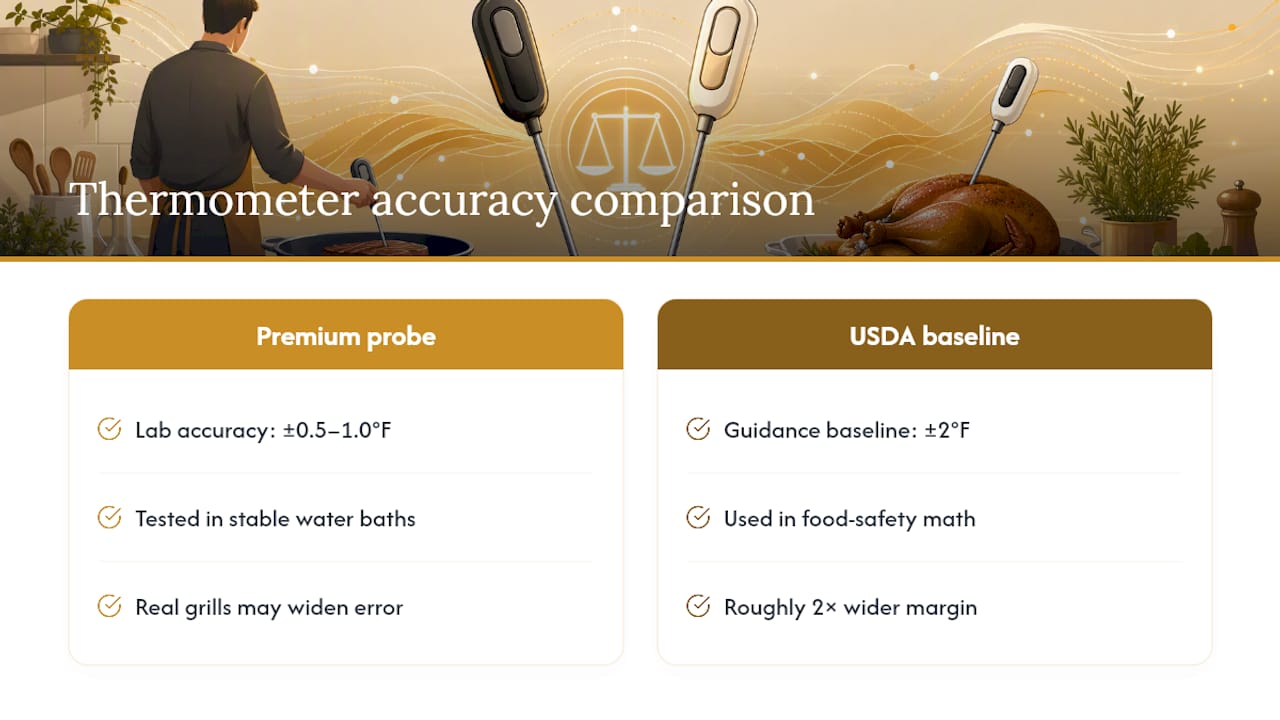
Statistic Callout: Premium smart wireless thermometers typically hit ±0.5°F to ±1.0°F accuracy under controlled testing. The USDA’s food-safety guidance assumes a baseline accuracy of only ±2°F. That means a well-placed smart probe gives you roughly twice the precision the government’s own safety math requires.
Most “inaccurate” readings trace back to three predictable habits, not defective hardware.
The biggest one is placement. Push a probe tip into or near bone, and you’ll read the bone’s temperature, not the meat’s. Fat pockets do something similar, since fat heats differently than muscle. FSIS guidance specifically warns against inserting probes into bone or thick fat for exactly this reason. Aim for the thickest part of the cut, away from both.
The second habit is impatience. A probe needs time to match the surrounding temperature after insertion.
The third issue is specific to wireless models: the ambient sensor built into the probe handle. That sensor sits close to cold meat, which acts like a heat sink and pulls the reading down. Add evaporative cooling from grill smoke and steam, and that handle-mounted ambient number can be off by a wide margin, which is exactly why serious barbecue testers recommend a separate wired ambient probe for tracking cooker temperature.
One more wrinkle: a stale Bluetooth or WiFi connection can show you a cached reading from thirty seconds ago, which looks like sensor drift but is really a signal problem.
Pro Tip: If your app shows a temperature that seems frozen or lagging, check the connection before you touch the probe. A dropped signal freezes the last reading on screen, and it’s easy to mistake that for a broken sensor.
Two simple tests, using water you already have on hand, will tell you whether your probe needs calibration or replacement.
| Test | Expected Reading | Acceptable Range |
|---|---|---|
| Ice bath | 32°F | 30–33°F |
| Boiling water (sea level) | 212°F | 209–213°F |
| Reference comparison | Matches instant-read | Within 1–2°F |
If your probe lands outside these ranges consistently, don’t panic; do the test twice more to rule out a fluke. If the gap holds, independent testing recommends treating anything more than 1 to 2°F off from a calibrated reference as a sign the unit needs replacement, since most consumer probes aren’t designed for field recalibration the way professional-grade thermocouples are.
Print this list, screenshot it, whatever works. Run through it before every cook that matters.
Pro Tip: Set a reminder to run the ice-bath test at the start of grilling season and again before any holiday cook that really matters. Thirty seconds of testing beats guessing at a $60 brisket.
| Situation | Best Practice |
|---|---|
| Leave-in probe, thick roast | Allow extra equilibration time; confirm with a second check before pulling |
| Instant-read, quick check | Wait 5–10 seconds; insert at an angle to reach the center |
| Tracking cooker temp | Use a wired ambient probe, not the wireless handle sensor |
| Long smoke with ETA feature | Treat time estimates as rough guides, not fixed countdowns |
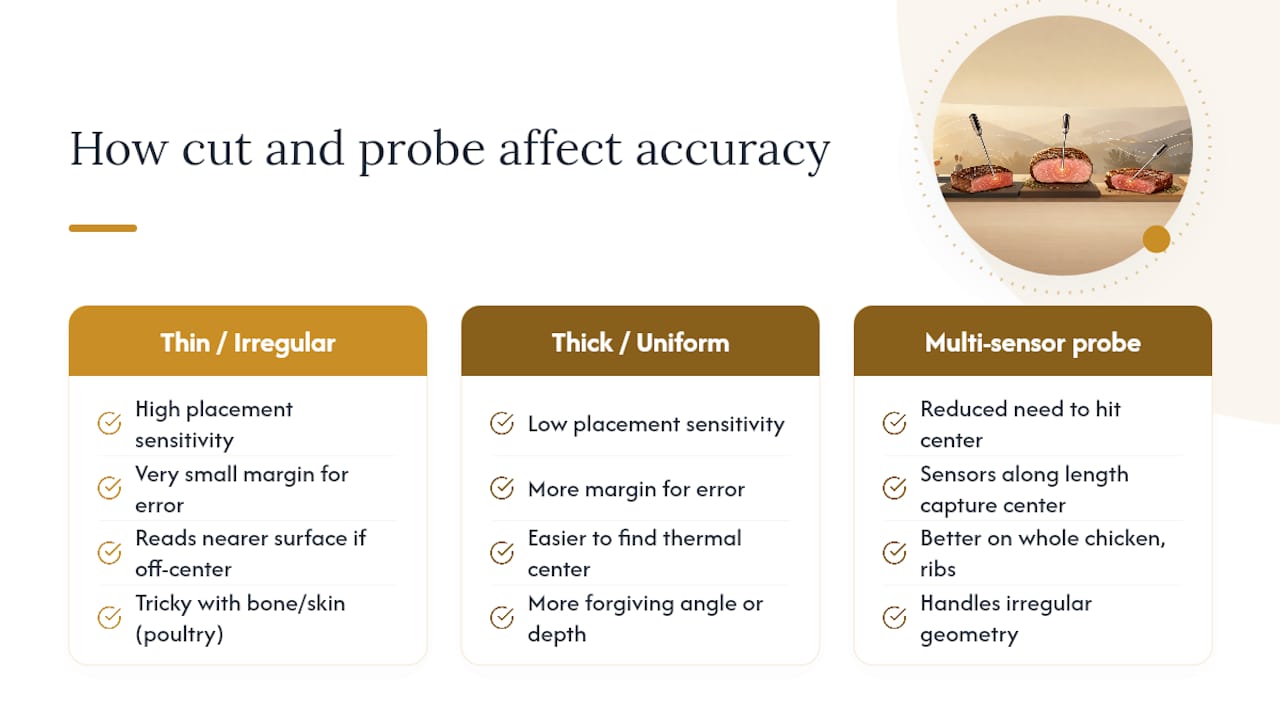
Thin cuts punish sloppy placement far more than thick ones do. A one-inch pork chop gives a probe almost no margin. Miss the center by a quarter inch and you’re reading closer to the surface, which cooks faster and runs hotter than the middle. A thick roast or whole turkey breast is more forgiving because there’s more room to land near the thermal center even with an imperfect angle.
Density and fat content matter too. Ground meat conducts heat differently than a solid muscle cut, and a marbled ribeye reads differently near a fat seam than in the lean muscle beside it. Poultry with skin and bone close together, like a chicken thigh, is one of the trickiest reads in home cooking because both the skin and the bone throw off the reading if the probe drifts even slightly toward either.
This is exactly why multi-sensor probes earn their keep on inconsistent shapes. A single-point sensor forces you to guess the geometry of the cut and hit the thermal center on the first try. A probe with sensors spaced along its length has a better shot at capturing the true center regardless of the cut’s shape, especially on irregular items like a whole chicken or a rack of ribs where the “thickest part” isn’t always obvious from the outside.
The practical takeaway: thinner and more irregular cuts deserve extra attention to placement, while thick, uniform roasts give you more room for error before accuracy actually suffers.
A dying battery doesn’t usually make a probe lie to you outright, but it can make it slower and less consistent. Low voltage can lengthen response time, which matters most during the equilibration window when you’re waiting for a stable reading. A probe running on a nearly dead battery might take twice as long to settle, and if you pull your reading before it truly stabilizes, you’ll log a number that’s still catching up to reality.
Wireless connectivity is the bigger casualty of low battery. A weak charge can cause a probe to drop its Bluetooth or WiFi connection more often, which means your app displays a cached reading instead of a live one. That cached number can sit on screen for a worrying stretch during a long smoke, giving you false confidence that nothing has changed when the meat has actually climbed several degrees.
Extreme heat exposure over repeated cooks also shortens battery lifespan faster than normal use would, so a probe that’s been through dozens of high-temperature smokes may need charging more often than one used occasionally for quick grilling. Check charge level before any cook longer than an hour, and keep a charging cable near your outdoor cooking setup if you smoke regularly. A probe with a full charge and a stable connection removes one entire category of “why is this reading wrong” troubleshooting before you even start cooking.
Neither tool wins every scenario, and pretending otherwise sets you up for the wrong purchase.
Instant-read thermometers are unmatched for quick spot checks. Searing a steak, checking multiple chicken pieces on a crowded grill grate, or confirming a quick weeknight pork chop is done all favor a fast, single-point read you can pull out, use, and put away in seconds. Popular Mechanics’ testing of wireless smart probes found they hold up well against published specs, but a leave-in probe simply isn’t built for a two-minute sear where you’re checking temperature six times in quick succession.
Smart, wireless leave-in probes earn their place on long cooks: a beef brisket running eight to twelve hours, a whole turkey, or a pork shoulder you don’t want to babysit for an entire afternoon. Real-time tracking on your phone means you’re not opening the lid every twenty minutes just to check a number, which itself helps you cook better by keeping heat and smoke consistent inside the cooker.
The realistic answer for most grilling enthusiasts is owning both. Use the instant-read for quick checks and multi-piece cooks, and reach for the wireless leave-in probe whenever a cook stretches past an hour and you’d rather monitor from the kitchen than stand at the grill the whole time.
Chasing the last tenth of a degree on a spec sheet is the wrong obsession. A ±0.5°F probe used carelessly will underperform a ±1.0°F probe used with good technique every single time. Accuracy on paper and accuracy on your plate are two different things, and the gap between them is almost always technique, not hardware.
The fix isn’t complicated. Test your probe before it matters, place it deliberately instead of jamming it in wherever’s easiest, and give it the few extra seconds it needs to settle. That routine, repeated every cook, is what separates people who trust their thermometer from people who keep buying a new one hoping this one will finally “work right.”
Before your next big cook, whether that’s a holiday turkey or a weekend brisket, take thirty seconds and run the ice-bath test. It’s the cheapest insurance you’ll find in your kitchen.
— Tony
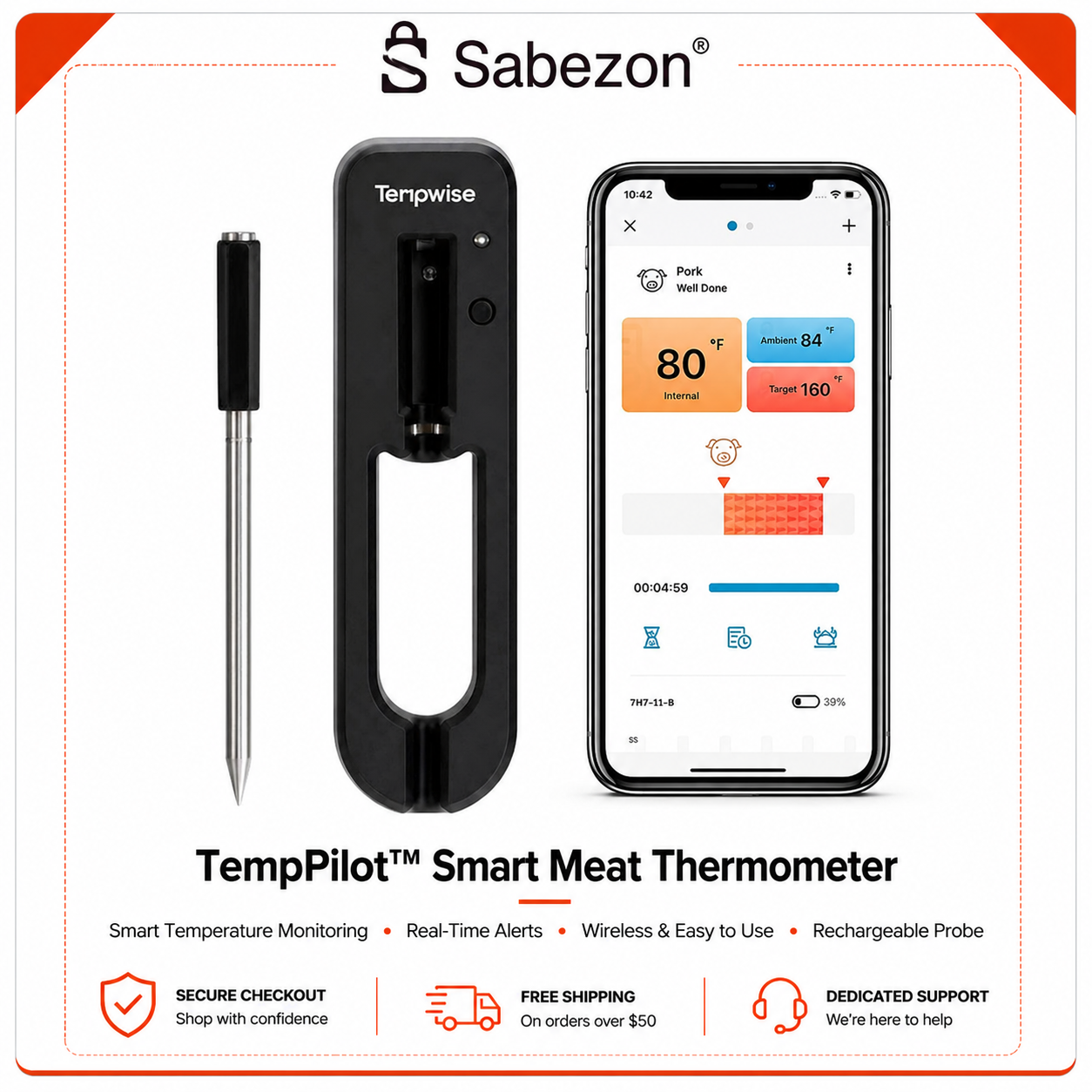
Sabezon built the TempPilot™ Smart Meat Thermometer around the exact problem this article just walked through: home cooks don’t need another gadget with impressive numbers on the box, they need a probe that’s simple to place correctly and easy to trust while it’s doing its job.
Some smart meat thermometers pair real-time app tracking with placement and equilibration guidance that helps determine whether a reading matches reality. No confusing setup, no digging through a manual mid-cook. If you want the full walkthrough on getting it set up for grilling, the TempPilot™ setup guide covers pairing, probe placement, and app alerts step by step. Ready to stop second-guessing your grill thermometer? Browse the Smart Kitchen collection and pick up TempPilot™ before your next cook.
Both typically fall within ±0.5°F to ±1.0°F under controlled testing, meaning neither has a clear precision advantage over the other. The real difference is speed and use case: instant-read probes respond faster for quick spot checks, while smart leave-in probes track long cooks without repeated lid-opening.
Oven thermostats and meat probes measure completely different things: air temperature versus internal meat temperature. An oven set to a high temperature doesn’t mean your roast is anywhere near that temperature inside, so comparing the two numbers directly is a mismatch, not a sign of a broken probe.
Most consumer smart probes aren’t designed for field recalibration, but running an ice-bath test once or twice a season confirms whether yours is still reading correctly. If it’s off by more than 1 to 2°F from a known reference consistently, replacement is usually the practical option.
Not for controlling cooker temperature. Handle-mounted ambient sensors sit close to cold meat, which acts as a heat sink and skews the reading low, so a separate wired ambient probe gives a more reliable number for tracking your grill or smoker.
TempPilot™ is built around the same placement and equilibration practices covered in this guide, giving home cooks a straightforward way to apply them without extra setup. Full specs and setup details are available on the TempPilot™ product page.