Cart
0
Complete Your Setup


Facial steamers and steam inhalation give real, temporary relief for stuffy noses, but they are a comfort tool, not a cure. Most people feel looser mucus and breathe easier shortly after using steam, and that relief usually fades in a few hours. Try a short, careful session tonight. Call a doctor if you have a fever, facial pain, or symptoms that persist. A simple facial steamer can be built for exactly this kind of safe home use.
TL;DR:
- Facial steamers provide short-term relief by loosening mucus and reducing nasal swelling, but they do not treat underlying causes like infections or allergies.
- The most effective routine combines steam sessions before bed with saline nasal rinses in the morning, enhancing mucus clearance and easing breathing.
- The main safety concern is the risk of burns, which can be minimized by maintaining appropriate distance, using a device with automatic shutoff, and testing steam temperature beforehand.
- Steam’s relief lasts a few hours and varies by illness; it is most helpful for temporary symptom easing during colds or allergies.
- Choose a steamer with adjustable steam control, a removable water tank, and an auto shutoff, and avoid using it if symptoms worsen or include severe facial pain or fever.
If you want fast relief without overthinking it, the Sabezon Calira™ Facial Steamer is built for exactly this job. It heats water into a gentle, even mist, keeps the nozzle at a safe distance from your face, and shuts off automatically when the tank runs dry. That’s the kind of low-drama design you want when you’re congested and not in the mood to babysit a gadget.
Not ready to buy a dedicated facial steamer, or want to know what else is out there? Here are three practical alternatives, each with a real tradeoff:
The combination that tends to work best is steam first, saline second. Warm mist loosens thickened mucus, and a saline rinse right afterward clears it out more completely than either method alone, according to research from the University of Southampton. Timing matters too. A steam session about 20 to 30 minutes before bed tends to pay off the most, since it can make breathing easier right when you need uninterrupted sleep. Pair it with a saline rinse in the morning and you’ve covered both ends of the day without reaching for medication.
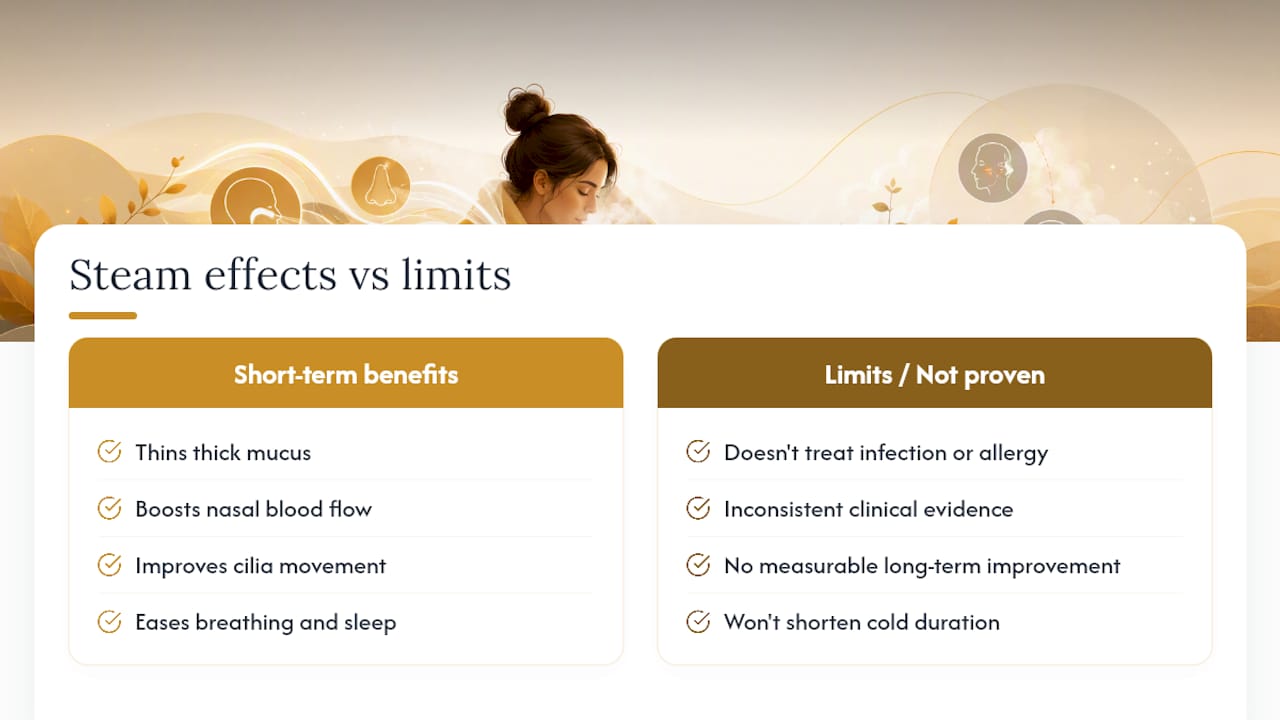
Warm, moist air does two things to a stuffy nose: it thins mucus that has thickened and dried inside your sinuses, and it briefly boosts blood flow to nasal tissue, which can reduce that swollen, blocked feeling. Steam also helps the tiny hair-like structures in your nasal passages, called cilia, move more efficiently. Cilia are supposed to sweep mucus and trapped particles out of your sinuses, but when tissue is inflamed or dried out, they slow down. Humidified air gives them a better shot at doing their job.
Here’s where the story gets more complicated than most product pages let on. A 2016 pragmatic randomized trial found that steam inhalation and nasal irrigation did not produce measurable improvement for people with chronic or recurrent sinus symptoms, even though a portion of participants said they felt subjectively better after using it, according to the University of Southampton. That gap between “I feel better” and “the test showed I got better” comes up again and again in this space. Medical News Today’s review of steam inhalers reaches a similar conclusion: the clinical evidence for steam reducing congestion is inconsistent, but plenty of people report genuine relief anyway.
That is not a contradiction so much as a mismatch between what steam is good at and what these studies were measuring. Steam is excellent at short-term symptom relief, the kind that makes it easier to breathe, sleep, or get through a workday. It is not doing much to change the underlying cause of your congestion, whether that’s a virus, allergens, or chronic sinus inflammation. Healthline’s guidance on steam inhalation draws that same line clearly: steam eases symptoms, it does not treat the infection or allergy causing them, and it will not shorten how long a cold sticks around.
That distinction matters for how you use it. If you’re dealing with a common cold, steam can make the next few hours more bearable while your immune system does the actual work. If you’re dealing with allergies, steam tends to loosen mucus faster because allergic congestion is usually thinner and less stubborn than the thick, sticky mucus that builds up during a cold. Either way, the relief window you experience is user-reported, not something a device manufacturer can promise you on a label, and it varies a lot from one person and one illness to the next.
None of this means steam is a waste of time. It means you should think of it the way you’d think of a heating pad for sore muscles: genuinely useful for how you feel right now, not a substitute for treating whatever is actually wrong.
The biggest real risk with any steam device is thermal scalding, not some rare skin reaction. Clinical reports on at-home steam devices document burns from people leaning too close, tipping over a unit mid-session, or handling water and tanks while they’re still hot, according to a PMC review of burn risk with steam devices. The fix is not complicated, but it does require actually following it instead of eyeballing distance because you’re impatient to feel better.
Safe distance depends on the device type. A mask or nozzle style personal inhaler is designed to sit just a few inches from your face, since the steam volume is smaller and more contained. An open facial steamer needs a bigger buffer, typically somewhere between 8 and 20 inches, because it releases a broader plume of hot mist, according to the same PMC safety review. When you’re not sure which zone your device falls into, check the manual and default to more distance, not less.
Certain people should be more cautious, or skip facial steaming altogether:
Pro Tip: Test the steam on the back of your hand for a few seconds before you bring your face anywhere near the device. If it feels too hot on your hand, it’s too hot for your nose and cheeks.
A short safety checklist covers most of what goes wrong in practice. Use distilled or filtered water if your device calls for it, since mineral buildup from tap water can clog the heating element over time. Set a timer instead of guessing at session length. Never leave a child alone with a running steamer, and skip essential oils entirely if kids are anywhere near the device. Let the unit cool completely before you move it, empty it, or clean it.
Stop steaming and call a doctor if you notice a fever that will not break, severe facial pain or pressure, bloody mucus, worsening shortness of breath, or congestion that drags on well past what a typical cold should last, according to Mayo Clinic’s guidance on nasal congestion. Those are signs of something steam was never designed to fix.
You don’t need a manual’s worth of instructions to do this safely. Here’s the routine that covers setup, the session itself, and cleanup:
On frequency, once or twice a day is a reasonable ceiling. Steaming more often than that without paying attention to how your skin and airways respond can lead to irritation instead of relief. If you notice mineral deposits building up around the heating element, a periodic descaling with a vinegar and water rinse (check your manual first) keeps performance consistent and extends the device’s life. A full walkthrough on facial steamer routines covers session pacing and upkeep in more depth if you want the longer version.
Most people notice a difference fast. Relief from a facial steamer or steam inhaler typically starts shortly after use and may peak within about 10 to 15 minutes, as mucus loosens and nasal passages feel less swollen. That relief is user-reported rather than clinically measured, and it tends to stick around for a few hours before congestion creeps back.
How long it lasts depends heavily on what’s causing the congestion in the first place. Thick, sticky mucus from a cold usually needs a longer session and doesn’t clear as dramatically, since the underlying inflammation is still working itself out. Allergy-related congestion tends to respond faster and more completely, since the mucus is typically thinner and steam alone can loosen it without much additional effort.
The best pattern most people land on is a single evening session, right before bed. It sets you up for a few uninterrupted hours of easier breathing exactly when disrupted sleep would otherwise make everything feel worse the next day. Doubling up mid-morning is fine occasionally, but steaming more than twice a day starts to risk irritating nasal tissue rather than soothing it.
Keep the bigger picture in view. Steam is a genuinely useful comfort tool for the average cold or allergy flare, but it is not built to manage chronic sinus disease, recurring infections, or anything that needs an actual medical diagnosis. If congestion keeps coming back or drags on for weeks, that’s a conversation for a doctor, not another steam session.
We think facial steaming earns its place in a home care routine, but only when it’s treated honestly: a comfort tool for tonight’s stuffy nose, not a promise printed on a box. Too many wellness products lean on vague “detox” or “cure” language that steam has never actually delivered. The evidence supports something more modest and still genuinely worthwhile, which is why we build and recommend devices around that honest expectation instead of an inflated one.
When we think about what makes a facial steamer worth having in a bathroom cabinet, three things matter more than flashy extras: how easy it is to clean, whether it shuts off on its own when the water runs low, and whether you can actually adjust the steam intensity instead of getting one fixed blast. Those are the features that turn a gadget you use twice and abandon into one you reach for every time you feel a cold coming on.
If you want the fuller walkthrough on getting the most out of a session, our step-by-step steaming routine breaks down pacing and upkeep in more detail than a quick recap can cover.
— Tony
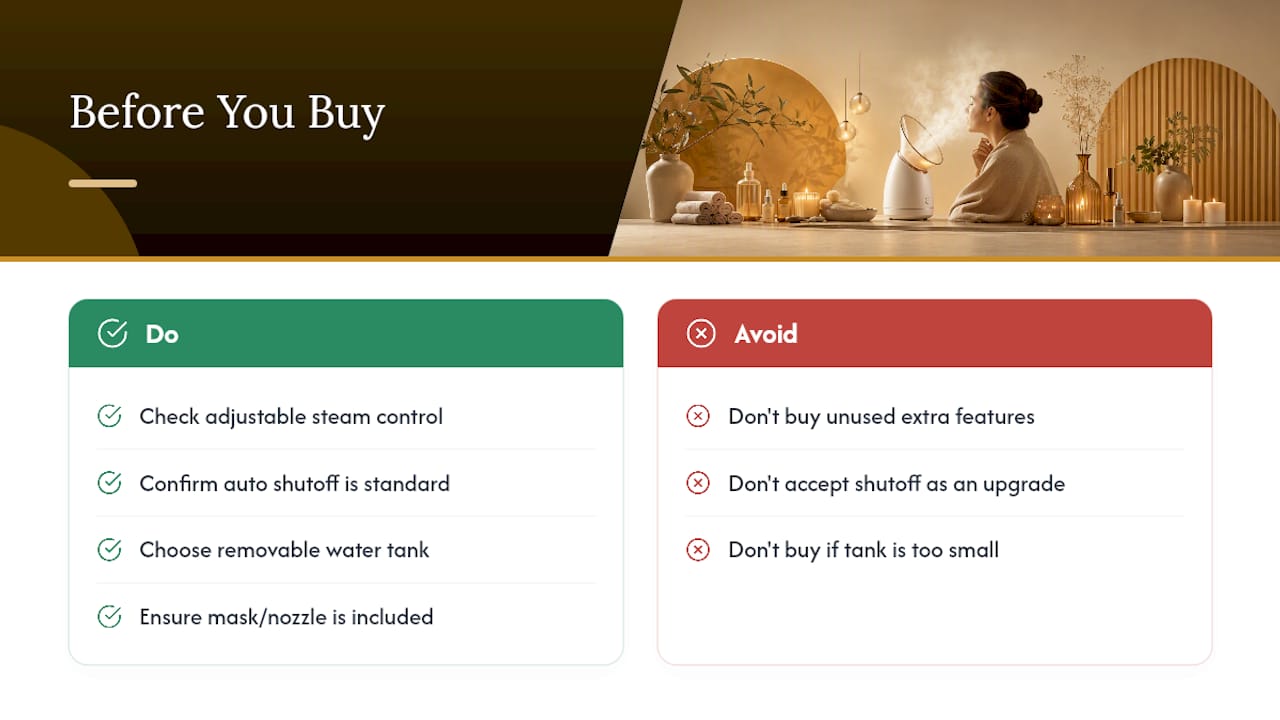
A facial steamer earns its spot on your bathroom counter by getting a few basics right, not by piling on features you’ll never touch. Before you buy anything, check for adjustable steam control, so you can dial intensity up for stubborn congestion or down for sensitive skin. Look for an auto shutoff feature, which protects against the scald risk we covered earlier if you ever walk away or forget the timer. A removable water tank makes cleaning and descaling dramatically easier than a fixed reservoir. And if you plan to use targeted relief for sinuses specifically, a device that comes with a mask or nozzle attachment gives you more control over where the steam actually goes.

The Sabezon Calira™ Facial Steamer checks each of those boxes without turning steaming into a chore. It’s built with adjustable steam settings so you can start gentle and increase intensity as your face adjusts, an auto shutoff that kicks in when the tank empties, and a removable tank that makes rinsing out mineral buildup a thirty-second job instead of a wrestling match. For anyone who wants an easy, reliable way to fit steam therapy into a nightly routine without babysitting a finicky machine, it’s a practical fit.
Before you check out, run through this short buying checklist: confirm the tank size matches how long you actually want to steam, verify the auto shutoff is standard rather than an upgrade, and make sure any mask or nozzle attachments you want are included rather than sold separately. If those boxes are checked, you’re ready to add relief to your routine. Browse the full Calira facial steamer listing or explore Sabezon’s wider smart home tech collection to see what else fits your routine.
The claims in this guide lean on a mix of clinical research and patient-facing medical guidance, not marketing copy:
If your congestion is severe, persistent, or paired with fever or facial pain, treat this guide as a starting point and talk to a clinician directly.