Cart
0
Complete Your Setup


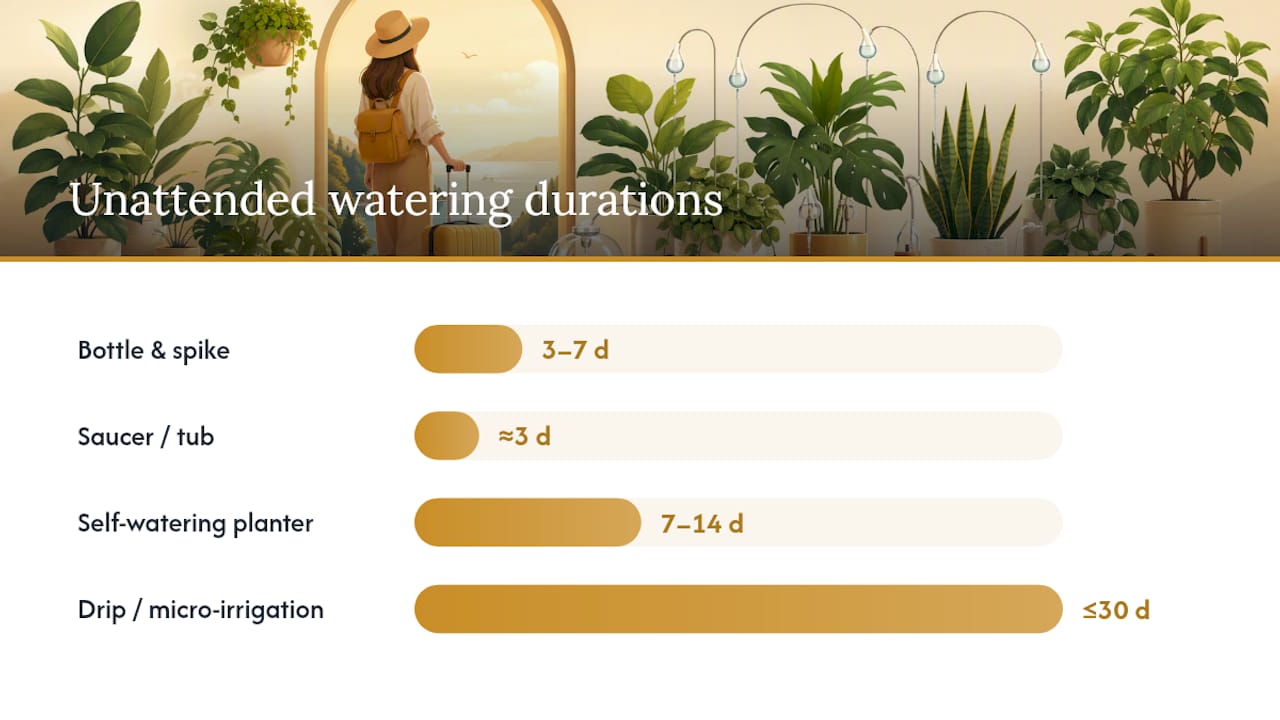
For a weekend away, deep water and group your plants; for one to two weeks, self-watering reservoirs or wicking systems do the job; for two to four weeks, a drip system on a timer (or a plant sitter) is your safest bet; past four weeks, hand your plants to a sitter or a neighbor. Whatever you pick, test it for at least five days before you leave.
TL;DR:
- Automatic watering systems like drip timers and self-watering planters are most reliable for trips of two to four weeks, provided they are properly tested beforehand.
- Self-watering containers and wicking systems comfortably support a one to two week absence but require careful reservoir filling and a five-day test run.
- For trips shorter than a week, grouping pots or using bottle and spike watering works well, but these methods are ineffective past the three to seven-day window without a backup.
- Longer absences beyond four weeks demand human intervention, such as a plant sitter or neighbor check-ins, since unattended systems cannot reliably last that long.
- Proper preparation, including a full system test, correct pot size, and intelligent scheduling, is crucial to prevent failures and ensure plants stay healthy during your absence.
You don’t need a greenhouse budget to keep plants watered on vacation. Most methods fall into a handful of categories, and picking the right one comes down to trip length, plant type, and how much setup you’re willing to do the night before your flight.
Here’s the practical shortlist:
Tropical plants with thin leaves lose water fast and need more frequent moisture than succulents, which can coast for weeks on stored water. Small pots under six inches dry out far quicker than a 10 to 15 gallon container, so pot size changes your whole plan.
Trip length is the single biggest factor in choosing a method, but pot size and plant type shift the math in both directions. Use this as your starting point, then adjust based on how thirsty your plants actually are.
Larger, unglazed clay pots breathe and dry out faster than plastic or glazed ceramic, which hold moisture longer. Match your container material to your trip length, not just your plant.
Each method has its own learning curve, its own failure points, and its own realistic capacity. Knowing the limits before you leave saves you from an unpleasant welcome-home surprise.
A wicking system uses a cotton cord or strip of fabric to pull water from a reservoir into the soil through capillary action. Here’s how to build one:
A single wick with a gallon reservoir typically covers 7 to 14 days for a medium pot, longer for smaller, less thirsty plants. This method works especially well for tropicals like pothos, peace lilies, and ferns that want consistent moisture.
Fill a bottle with water, invert it into the soil, or attach a ceramic or plastic watering spike to the neck. Gravity and soil moisture control the drip rate. It’s cheap, fast to set up, and genuinely useful for short absences.
The catch: capacity is limited. Most bottle setups last 3 to 7 days depending on pot size and heat, and they fail quietly. The bottle empties, nobody notices, and the plant sits dry for the rest of the trip, according to Farm to Jar. Don’t rely on this for anything past a week without a backup plan.
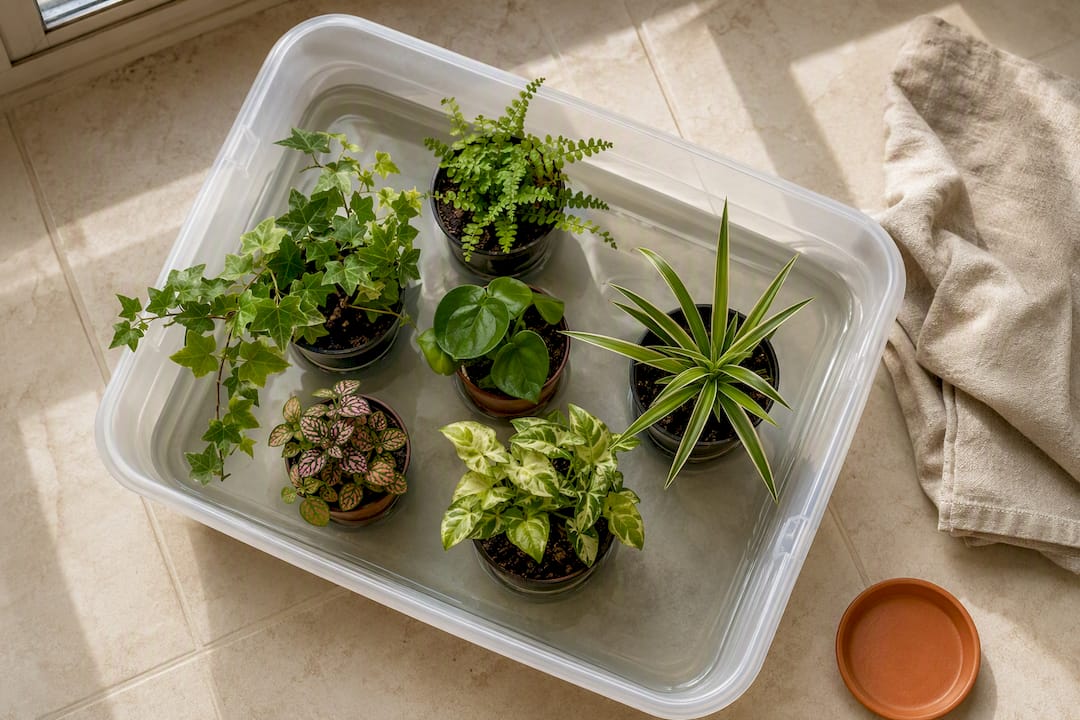
For smaller pots, set them in a shallow tub or bathtub with an inch or two of water. Roots draw up moisture from the bottom, and the humid microclimate slows evaporation from the leaves. This works well for a handful of pots over a long weekend, but it’s not a long-term fix. Water evaporates, soil eventually dries, and you’re limited by how many pots actually fit in your tub.
These use a built-in reservoir, usually with a wick, cord, or capillary matting connecting the water to the root zone. As the soil dries, the plant pulls exactly what it needs from below.
Reservoir size and pot volume both matter here. A reservoir paired with an appropriately sized pot and a moisture-retentive potting mix keeps a plant hydrated for one to two weeks without becoming waterlogged, per University of Maryland Extension. Refill the reservoir fully right before departure, and check that the wick or capillary connection is seated properly. That single point of contact is where most self-watering setups fail.
A drip system pairs small emitters or micro-tubing with a hose-end timer that controls when and how long water flows. Components are simple: a timer, a splitter if you’re running multiple lines, tubing, and emitters sized to each pot.
Set your timer to run early in the morning, when evaporation is lowest. Start with the shortest available duration and check soil moisture 24 hours later before adjusting up, a scheduling approach Global Flowers recommends specifically to avoid overwatering. A properly sized system handles 10 to 20 pots for up to 30 days, making it the strongest option for medium and long trips among unattended setups.
Pro Tip: Buy a mechanical timer with a manual override switch. If your trip gets extended or weather turns unexpectedly hot, a neighbor can bump up the watering frequency without needing an app or a manual.
For outdoor beds, a rain barrel elevated on a stand can feed a soaker hose through gravity alone, no electricity or pump required. It’s practical if you already collect rainwater and have a bed close enough for hose reach. The constraint is capacity. A single barrel empties fast across a large bed, and output drops as the barrel level falls, so this suits smaller garden sections better than a full landscape.
Outdoor plants and containers need a different kind of prep than the ones on your windowsill, mostly because sun and wind pull moisture out of soil far faster outside.
Start with a deep watering session the day before you leave. Soak the top 12 inches of soil in garden beds so roots have a real reserve to draw from, a baseline UF/IFAS recommends for landscape plants heading into any absence. Follow that with a fresh 2 to 3 inch layer of mulch across beds, which meaningfully slows evaporation and buffers soil temperature during hot stretches, per the same UF/IFAS guidance.
For container plants, a few adjustments go a long way:
If you’re running automated irrigation outdoors, set it up and test it before you go, and check whether your city or homeowners association has watering-day restrictions that could interfere with your schedule. For anything beyond a month, or a yard with more beds than you can rig with timers, it’s worth calling in a local landscaping service to handle maintenance while you’re gone, or arranging a plant sitter for regular indoor and outdoor rounds.
Skipping the test run is the single most common reason vacation watering setups fail. Run your full system, whatever it is, at least 5 days before departure so you have time to catch problems and fix them, not just discover them from your hotel room.
Global Flowers puts this five-day window at the center of any reliable automated setup, since problems that show up on day one are easy to fix and problems that show up on day ten are not.
Before you actually leave, run through a short checklist: full plant inventory with locations, written watering notes for anyone checking in, reservoirs topped off, timers double-checked, and an emergency contact number taped somewhere visible. It takes ten minutes and eliminates most of the guesswork for whoever’s helping out.
A self-watering planter is designed for the gap that trips up most indoor gardeners: the one to two week window where hand-watering isn’t an option but a full irrigation system feels like overkill. It works on the same reservoir principle described above. Water sits in a base chamber and moves up into the soil as the plant draws it down, keeping moisture steady without soaking the roots.
It’s a strong match for a few specific situations:
It’s not built for everything. Succulents and cacti prefer to dry out between waterings, so a constantly available reservoir can work against them. And for trips past a month, no self-watering planter replaces a sitter checking in.
Fill the reservoir completely before you leave, and give the Verdara™ planter a short test run indoors first, watching how fast the water level drops with your specific plant and potting mix. For guidance on matching planter size to your plant, Sabezon’s blog post on choosing the right planter size walks through the sizing math, and the self-watering planters for herbs guide covers setup details specific to kitchen herb gardens.
The biggest mistake I see in vacation plant care isn’t picking the wrong method. It’s skipping the test run and assuming a system will just work because it worked for someone else’s plants in someone else’s apartment. Every setup depends on your specific pot size, your specific potting mix, and your specific plant’s thirst level, which is exactly why a five-day trial before departure isn’t optional advice, it’s the difference between coming home to healthy plants and coming home to a mess.
Two things I’d tell anyone in a hurry: buy pots bigger than you think you need, since a 10-gallon container buys you days of buffer that a 6-inch pot simply doesn’t have. And set your irrigation timer for early morning, never midday, because you lose far less water to evaporation before the sun gets high.
Whatever system you land on, leave a written note for whoever’s checking on things. “The ferns get watered Tuesday” means nothing to someone standing in your living room with no context.
— Tony
If you’ve read this far, you already know self-watering reservoirs are one of the most reliable fixes for the one to two week trip that trips up most plant owners. A self-watering planter can make that fix as close to effortless as possible: fill the reservoir, set the plant, walk out the door.
It’s a straightforward option for herb gardens, balcony plants, and any indoor greenery that needs steady moisture without a full irrigation setup. It won’t cover a month-long trip on its own, and it’s not the right call for succulents that want to dry out between drinks, but for the short-to-medium window where most vacations actually fall, it takes one more thing off your pre-trip checklist. Check the Verdara™ Self-Watering Planter page for sizing details, or browse Sabezon’s full smart home tech collection if you’re looking to simplify more than just plant care before your next trip.