Cart
0
Complete Your Setup




The best stick vacuum for hardwood floors has a soft roller head, a brush roll you can switch off, moderate suction and a battery that lasts long enough for your whole floor plan. Skip the biggest spec numbers. A vacuum that scatters crumbs or scuffs the finish is not a good fit for wood, however strong the motor.
This guide shows what matters, what is mostly marketing, and how to keep a wood floor looking good with a few minutes of cleaning a day. Smart Products. Zero Hassle.
Most vacuums clean hardwood well. Consumer Reports notes that most models it has tested earn excellent ratings on hardwood. The differences show up in the details: how the head handles debris, and how kind it is to the finish.
Two problems come up again and again.
Scatter. A head built for carpet can push dust and cereal across a bare floor instead of picking it up. Quartz, summarizing Consumer Reports, says the same: a carpet-first vacuum can scatter debris on hardwood, and a rough brush roll can dull a finish over years of use.
Grit. Dirt underfoot acts like fine sandpaper. The National Wood Flooring Association (NWFA) recommends sweeping or dust mopping daily and using a vacuum on the bare floor setting once a week or as needed. Dry cleaning, with the brush roll off where the vacuum allows it, matters more than wet cleaning.
A stick vacuum suits this job well. It is light, it lives where you can grab it, and you can clean up a spill in under a minute. That is why we sell them.

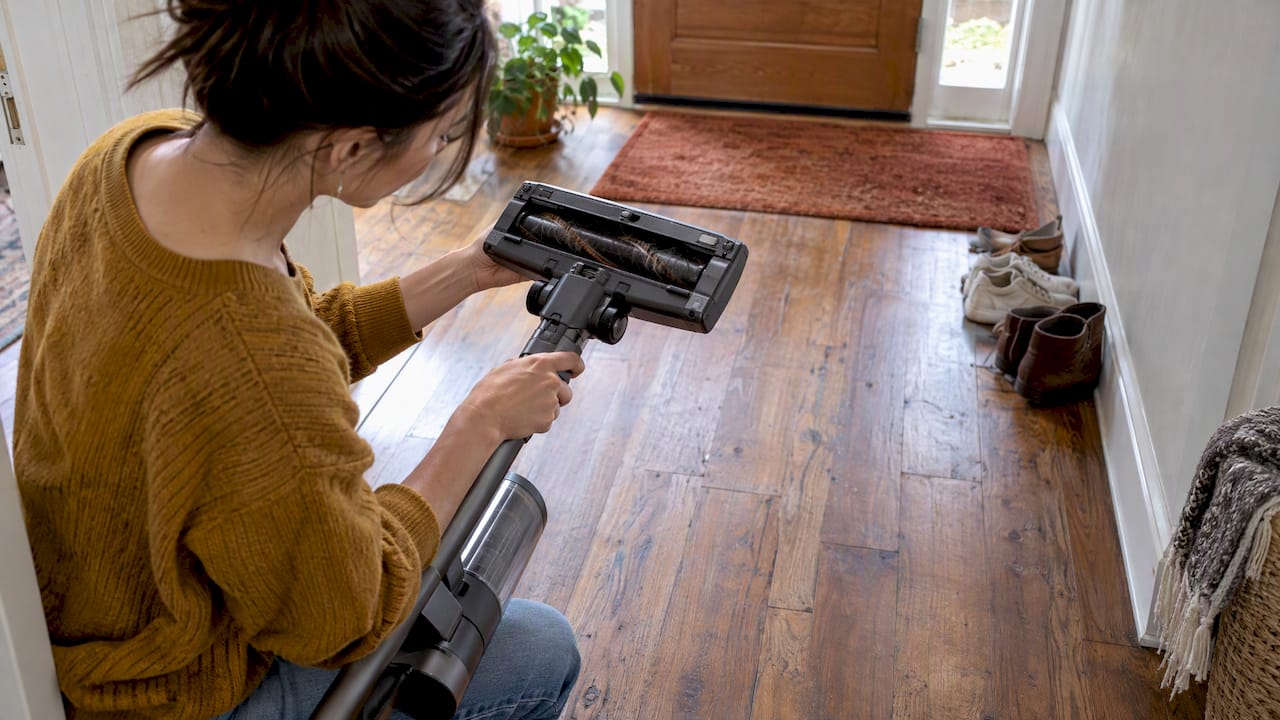
This is the single most useful feature on bare floors. A soft roller is a fabric or felt-style cylinder that glides over the surface. It picks up fine dust and larger crumbs without flicking them away.
In one hands-on review of a soft-roller stick vacuum, the tester reports it picked up rice, oats, fine dust and crumbs under a kitchen table, without scattering debris the way some stiff brush rolls do. Another review reports that a dual-brush-roll model performed best on hard floors, with near-perfect results on sugar, kitty litter and rice.
What this tells you: the head design counts for more than the motor on wood. Check the product page for the words “soft roller,” “soft brush,” or “brush roll off mode.”
Big suction numbers sell vacuums. On hardwood, they do not help much past a point. One 2026 stick vacuum comparison says 100 Air Watts, or about 20 kPa, is plenty for daily maintenance on hardwood, with diminishing returns beyond roughly 150 AW or 40 kPa.
Those units do not convert cleanly. The same source notes that 185 AW is roughly 25 kPa, but it depends on how each maker tests. Treat the numbers as a rough guide, not a precise ranking.
Powerful suction can also work against you on wood. It can pull a light rug toward the head or make the vacuum feel sticky on the floor. A low or medium mode helps.
Look for at least two power levels, plus a way to turn the roller off or slow it down. Some machines sense the surface and adjust brush speed. Consumer Reports notes one corded stick model with an auto-detect mode of that kind, along with a handheld conversion for stairs.
Auto modes save a step. They are handy if you move from kitchen tile to a wood hallway to a bedroom rug in one pass.

Battery claims need a careful read. A stick vacuum comparison points out that advertised runtimes are measured in low-power Eco mode without active attachments. With the brush roll running in Boost mode, expect about 5 to 18 minutes of real cleaning.
That is still fine for most hardwood homes. Hard floors need less power than carpet, so you can stay on a lower mode. Do a quick estimate:
| Home type | Typical need | What to check |
|---|---|---|
| Apartment or small condo | 10 to 15 minutes per clean | Standard battery on a low or medium mode |
| Two-story home, hardwood throughout | 25 to 40 minutes per full clean | Swappable battery, or plan to clean in two rounds |
| Open-plan home with pets | Frequent short sessions | Easy bin emptying and a hair-resistant head |
We cover this in detail in our guide to stick vacuum battery life, including why Boost mode drains the battery so quickly and how to get through a whole floor on one charge.
A stick vacuum you dislike lifting is a stick vacuum you will not use. Hold a model with the bin full, if you can. Check how it feels when you tilt it under a couch. Look for a slim neck, a head that lies flat and an LED headlight. A light shines across the floor and shows the dust you would otherwise miss.
Hard plastic wheels can leave marks on a soft finish if grit gets stuck to them. Rubberized wheels or a soft bumper are safer. Wipe the wheels and the head from time to time. It takes seconds.
A sealed system keeps fine dust inside the vacuum instead of blowing it back at the floor. A bin you can empty without touching the dust is a plus for allergy-prone households. A washable filter lowers the long-term cost.
Cordless is what most people picture, and it is the right pick for daily convenience. Corded can still win on consistency. Consumer Reports says its 2026 data finds that corded stick vacuums can provide top-tier bare-floor and pet-hair performance, often more consistently than some battery models, because they avoid runtime limits.
Here is how we think about the choice:
Most busy homeowners reach for the cordless option because it gets used more often. A vacuum that comes out every day beats a stronger one that stays in the closet.
Be realistic about mixed flooring. Vacuum expert Frank Rizzi, quoted by Consumer Reports, says a lightweight stick is often enough if you only have hardwood. For households with mixed floors, experts consistently suggest a more powerful upright or canister to pull embedded dirt out of carpet.
A good rule of thumb:
One review of a stick model shows the common pattern: strong hardwood performance, but carpet pickup that was only adequate. Know which of those you need most.
We curate smart home products for people who do not want to spend a weekend reading spec sheets. When we look at a stick vacuum for hardwood, we ask four plain questions. Is the head gentle on a finish? Can you switch the brush roll off? Is the weight comfortable for a daily pass? Is the battery honest about what it can do?
We think the daily habit matters more than the model. A light, easy-to-grab stick vacuum that you use for two minutes after breakfast keeps grit off the floor. That does more for the finish than a monthly deep clean with a heavy machine.
We also prefer simple setups. Charge it, mount it, use it. No app to pair, no accessories to hunt for. That is the idea behind our VacuumPilot Cordless Stick Vacuum, which we built our stick vacuum selection around. Check the product page for the exact specs before you buy, and match them to the checklist above.
Tested. Proven. Loved. That is the bar we hold every product to.
— Tony
The right machine helps. The right habits help more.
Flooring industry guidance from the NWFA points to the same cause: surface dirt and debris are the main reason hardwood scratches and wears.
Steam mops are not for hardwood. The NWFA warns that heat and vapor can get into the joints, leading to cupping and a cloudy finish, and that steam use can void a manufacturer’s finish warranty. Check your own warranty terms.
If you do need to mop, one flooring guide advises doing it sparingly with a pH-neutral cleaner and a barely damp microfiber pad. Standing water and soaking string mops are the main causes of dulling and cupping. If your floor has a special finish, ask your installer or the finish maker what they approve.
That also means a steam cleaner is the wrong tool for your wood floors, even if it is handy elsewhere in the house. Keep it for tile, grout and other sealed, non-wood surfaces.
They do different jobs, and many homes use both.
If your floors are mostly hard surface and you want hands-off upkeep, a robot is a strong partner for a stick. See our FloorPilot Smart Robot Vacuum, which is listed for hard floors, and read our guides on robot vacuums for pet hair and robot vacuum maintenance. If you have stairs, our guide on robot vacuums and stairs explains why a stick or handheld still earns its spot.
If you have pets, a stick vacuum plus a quick hair tool for sofas makes the daily routine easier. Our FurSweep Pet Hair Remover is made for sofas, carpet and clothes.
Before you check out, run through this list:
We keep the range simple: smart, easy-to-use cleaning tools that fit a busy week. Start with the VacuumPilot Cordless Stick Vacuum, or browse everything in our Smart Cleaning collection to pair it with a robot vacuum, a window cleaner or a pet hair tool. Shop Smarter, Live Better.
Yes, it can, mostly through the brush roll, hard wheels or trapped grit. A soft roller head, rubberized wheels and a switch-off option for the brush roll lower the risk. Keep the head and wheels clean, and pick up small stones by hand.
Not much. One 2026 comparison puts about 100 AW, or 20 kPa, as enough for daily upkeep on hardwood. Beyond roughly 150 AW or 40 kPa you get little extra benefit for routine floor care. Head design matters more than raw power.
Less than the box says. Advertised times are usually for low-power mode with no motorized attachment. With the brush roll running in Boost mode, expect around 5 to 18 minutes. On a low mode over hard floors you will get a lot more.
No. The NWFA warns that steam can cause cupping and cloudy finishes and may void a finish warranty. If you want a wet step, use a barely damp microfiber pad with a pH-neutral cleaner, and not often.
It depends on the carpet. For light rugs, a stick with a carpet mode can work. For thick wall-to-wall carpet, experts quoted by Consumer Reports suggest a more powerful upright or canister for embedded dirt. A stick still helps for quick jobs.