Cart
0
Complete Your Setup





A robot window cleaner is worth buying if you have several large, uninterrupted panes or hard-to-reach glass, and you’re comfortable staying nearby to supervise the run. It’s not worth it if your windows have muntins, heavy grime, or textured glass, or if you want a true “set it and forget it” fix. Think of it as a smart maintenance tool between deep cleans, not a replacement for one.
TL;DR:
- Robot window cleaners work best on large, flat, and uninterrupted glass panes, providing some help with high, hard-to-reach windows but struggling with textured, heavily soiled, or divided panes.
- They primarily handle light dust and fingerprints but are ineffective against heavy grime, dried-on dirt, or cleaning corners where sensors and pads cannot reach.
- Supervision during operation is necessary, as they often require pane-by-pane setup, and ongoing costs for pads and cleaning solutions can outweigh their convenience for some households.
- Exterior use is riskier in windy conditions, and safety precautions, including tether attachment and frame checks, are essential to prevent accidents.
- The total cost of ownership includes replacement pads, solutions, and parts, often making professional cleaning a more economical option for most standard homes.
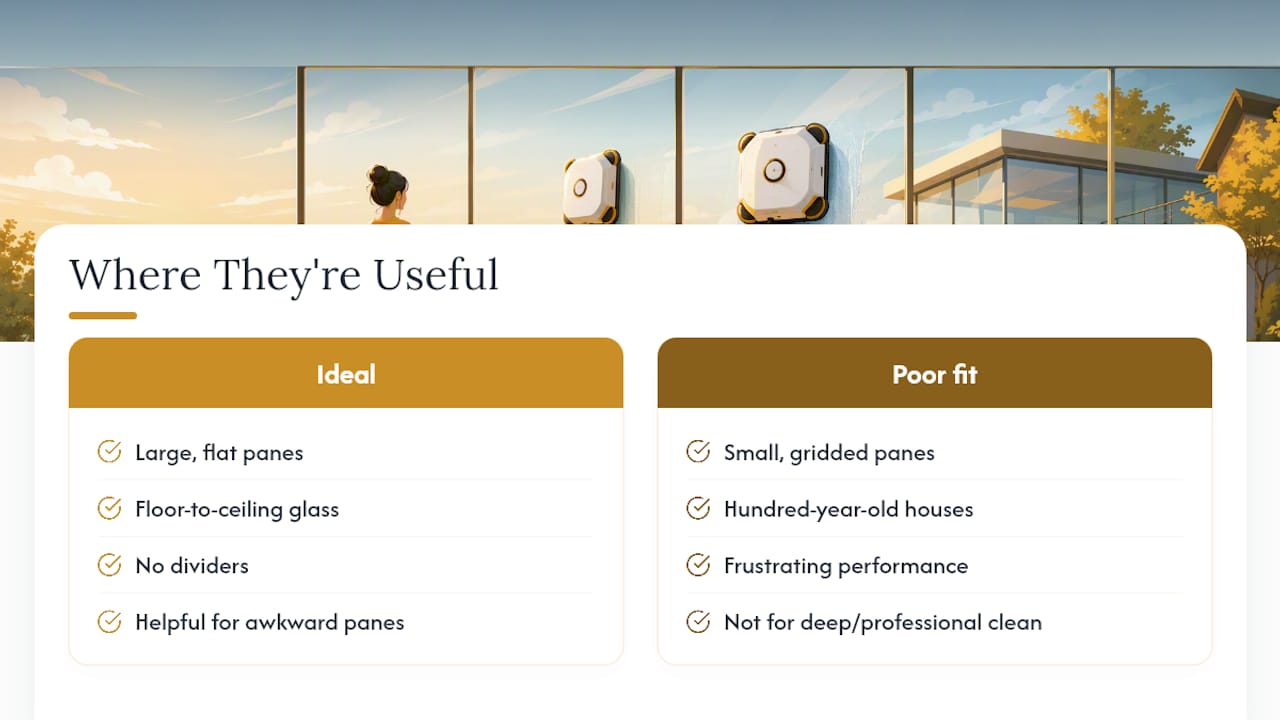
The honest answer depends less on the robot and more on your windows. Large, flat, floor-to-ceiling glass with no dividers is where these devices earn their keep. Small, gridded panes on a hundred-year-old house are where they fall apart.
Hands-on testers who’ve put these devices through real runs keep landing on the same conclusion: robot window cleaners are genuinely useful for a narrow set of situations and frustrating outside of them. Wirecutter’s test of the Winbot Mini found it improved clarity on a hard-to-reach, 12th-floor window, but it still needed active oversight and didn’t perform consistently on every window type. That’s the pattern across almost every serious review: real benefit on the right glass, real limitations everywhere else.
Multiple reviewers frame it the same way — a helpful tool for owners with many large, awkward panes, but a poor stand-in for a proper manual or professional deep clean, according to Yahoo Tech’s buying guide. If your gut reaction to that is “well, which one am I,” the sections below will settle it fast.
Every robot window cleaner on the market runs on the same basic formula: suction, pads, a little water, and a motion pattern. Understanding that formula explains almost every complaint you’ll read in a review.
TechRadar’s testing found that pad wetness is one of the biggest variables in outcome quality. Too dry, and the pad just buffs dust around instead of lifting it.
Robot window cleaners handle light maintenance well and struggle noticeably with anything heavier. That’s the consistent finding across independent tests, and it’s worth taking seriously before you spend money expecting a deep clean.
Statistic to know: Testing from Gizmodo on the Ecovacs Winbot W3 Omni found it handled light dust and fingerprints effectively, but struggled with heavy grime, bird droppings, and corners, and had real trouble on textured glass.
Where these devices genuinely shine:
Where they consistently fall short:
Wind matters too. Exterior use in even a light breeze can disrupt spray delivery, according to TechRadar’s findings, turning what should be a wet clean into something closer to a dry buff that smears dirt rather than lifting it. Pane size plays a role as well. Bigger panes give the robot more room to build momentum and cover ground efficiently, while small or oddly shaped panes mean more starts, stops, and manual repositioning.
Here’s where the decision actually gets made. A robot window cleaner isn’t free convenience. It trades one kind of effort for another, and whether that trade is worth it depends entirely on your specific windows.
The genuine advantages:
The real downsides:
Pro Tip: If you’re weighing this purchase, count your actual “problem” windows first. A robot earns its keep on three or four large, hard-to-reach panes. It’s a much weaker case if your whole house is small, gridded, older-style windows.
Picture two households. One lives in a modern condo with a wall of floor-to-ceiling glass twelve stories up. The other owns a craftsman bungalow with a dozen small, muntin-divided windows. The first household is the target buyer. The second is going to spend more time fighting the robot than the grime.
Buying the robot is just the entry fee. Ongoing maintenance is where the real cost shows up, and it’s rarely mentioned until after purchase.
Gizmodo’s testing flagged that consumables, especially replacement pads and the recommended cleaning solution, add up to a real ongoing cost if you want consistent results run after run.
Cost comparison worth running yourself: A single professional window cleaning visit for an average home typically runs somewhere in the range of a couple hundred dollars, depending on your region and window count. A basic squeegee, bucket, and cleaning solution kit costs a fraction of that and lasts years with occasional refills. A robot sits in between: a higher upfront cost than manual tools, plus recurring pad and solution costs, offset by the labor and ladder risk it removes from upper-floor glass.
Budget models add another wrinkle. Consumer NZ’s review of a low-cost robot found it smeared dirt and left circular pad marks, concluding that cheaper units work best as a maintenance pass after a proper manual clean, not a replacement for one.
Exterior use is where things can go wrong fast, and every serious review treats safety as non-negotiable rather than optional.
Answer these honestly and the decision usually makes itself.
If most of your answers point toward “yes, this fits,” a robot window cleaner is a reasonable buy. If you’re mostly shaking your head, save the money and put it toward a professional clean or a better manual kit.
Window cleaning robots fit the mission of providing smart-home tools that solve specific, everyday problems without adding complexity, but only when expectations are set correctly. Some products are designed around the reality this article lays out: strong suction adhesion, a backup safety system for peace of mind, and a pad-based cleaning approach built for large, accessible panes rather than heavily divided or textured glass.
This product isn’t positioned as a full replacement for a deep manual clean. It’s intended as an easy, reliable option for keeping large windows clear between deeper cleans, which is exactly where independent testing indicates this category performs best.
Author credentials, customer testimonials, and third-party certification details for GlassPilot™ are available on the product page.
— Tony
If your windows matched the checklist above, mostly large panes, some hard-to-reach spots, and you’re fine supervising a short run, the GlassPilot™ Smart Window Cleaner is built exactly for that situation. It’s designed for simple setup with no technical fuss, so you’re not troubleshooting an app before you’ve cleaned a single pane.
Before you buy any robot window cleaner, confirm three things: the return policy in case your window frames aren’t compatible, ongoing pad supply and pricing, and what the warranty actually covers if the suction motor or battery underperforms. Sabezon lists this information directly on the GlassPilot™ product page, so you can check fit before you commit.
If your windows lean toward small, gridded, or heavily soiled glass instead, a manual squeegee and sprayer kit will likely serve you better and cost less over time. Either way, browse Sabezon’s full Smart Cleaning collection to compare options side by side before you decide.
Yes, but with real limits. They clean light dust, fingerprints, and general haze effectively on large, flat panes, though hands-on testing shows they struggle with heavy grime, corners, and textured glass.
The main downsides are per-pane setup, the need to supervise each run, leftover residue in corners, and ongoing costs for pads and cleaning solution. Wired’s review found the process often takes more active effort than cleaning by hand.
It’s worth it if you have several large, hard-to-reach panes and don’t mind staying nearby during the cleaning run. It’s a weaker choice for small, gridded, or heavily soiled windows, where a manual clean or a professional visit will get better results for less money.
Yes, this is where they perform best. Wirecutter’s test on a 12th-floor window found noticeable improvement in clarity, even though the unit still needed oversight during the run.
Current pricing for the GlassPilot™ Smart Window Cleaner is listed directly on the Sabezon product page, where you can also check pad availability and warranty details before buying.