Cart
0
Complete Your Setup




Advertised wireless meat thermometer range is an open-air figure, and an enclosed grill or smoker will cut it sharply. Your real distance depends on the weakest link in the chain from probe to base to phone. As a rule of thumb, Bluetooth suits monitoring from nearby, while Wi-Fi and RF systems suit longer distances once they are placed well.
TL;DR:
- A Bluetooth probe measured about 100 feet in open air but only 30 feet inside a smoker; an extender raised that to 150–200 feet.
- Bluetooth suits patio monitoring, while thermometers using a home network depend on router coverage; lower frequency RF systems can better penetrate metal.
- Set the base beside the cooker rather than on its metal body, aim it toward your seating area, and place extenders halfway along the route.
- Before buying, check gateway or extender support, battery life, and app reconnection behavior, then test range both in open air and with the cooker closed.
Think of range as a chain of connections, not one number on a box. Your connection is only as strong as its weakest hop.
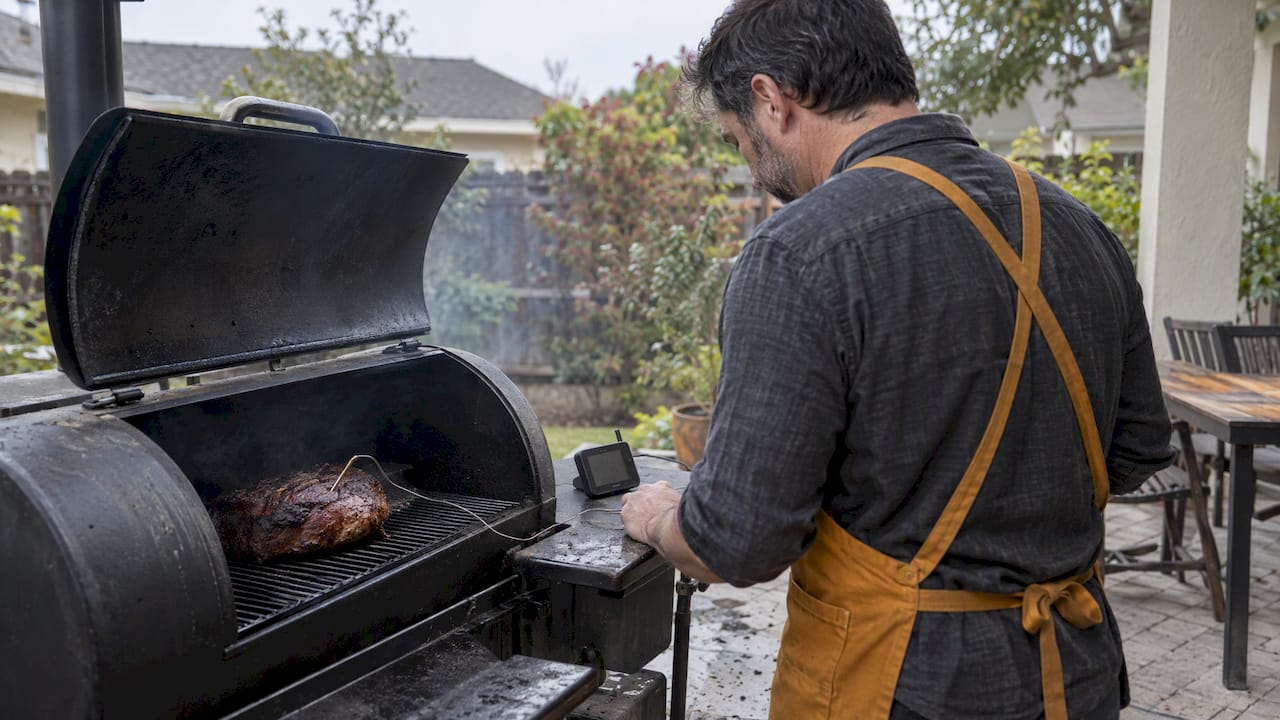
The first hop is where most cooks lose signal. A closed kettle grill or smoker has thick metal walls that block radio waves, so a probe that talks happily across a patio table can go quiet once the lid drops.
Which hop fails depends on factors such as line of sight, the radio frequency, and what the signal has to pass through. A wall of steel is a very different obstacle from a wall of drywall. That is why one headline range number tells you almost nothing about your backyard.

Each connection type has a nominal claim and a backyard reality.
ThermoWorks built its RFX system around this idea. Reviewers report it uses 433 MHz probes with a gateway to reduce signal loss from metal cookers.
Pro Tip: Pick stability over a big headline number. A thermometer that holds a steady link beats one that promises a long range and drops out mid-cook.
Field tests tell the story better than packaging. One reviewer measured a Bluetooth model at about 100 feet (30 m) phone to probe on a non-conductive table. Inside a Weber Smokey Mountain, reliable communication fell to around 30 feet (10 m). Adding the optional Xtender extender pushed range to about 150–200 feet (45–60 m).
Open air versus inside the cooker: the same Bluetooth probe went from about 100 feet to about 30 feet once it sat in a smoker, and an extender brought it back to roughly 150–200 feet.
Roundups from Serious Eats and Food & Wine take the same approach: they test in real grills and smokers and judge range and reliability, not just the spec sheet.
You can turn these examples into distance bands to size up your own setup:
Most dropouts can be fixed in minutes. Work through these steps in order:
Pro Tip: If the connection wobbles, move the base a few feet before you buy anything new. Placement alone often solves it. Our guide to thermometer placement shows where the probe should sit for reliable readings too. If your grill has its own app, this Weber Connect guide explains how a grill app fits into the workflow.
Use this checklist before you buy, and again after the box arrives.
If you want to understand why accuracy matters as much as range, our piece on smart thermometer accuracy is a good companion.
I put stability first, every time. A probe that reconnects cleanly after a brief drop is worth more than a bigger range number you will never use. Range starts to matter when you cook for a crowd, run a long overnight smoke, or want to check the cook from the couch inside. In those cases, the added setup of an RF or Wi-Fi system pays off. Whatever you buy, test it on your own grill. A quick check in your yard tells you more than any spec sheet.
— Tony
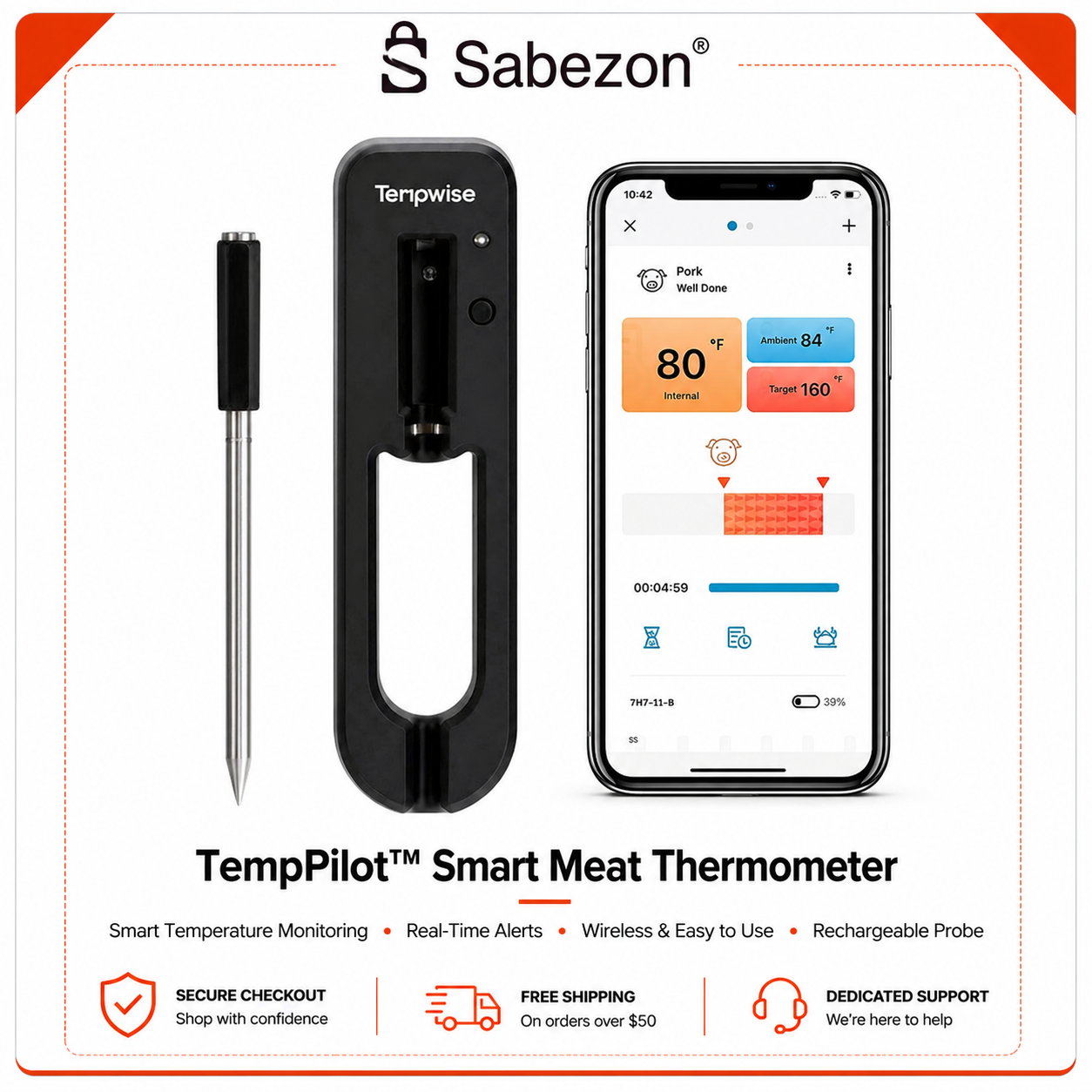
Smart cooking should not take a manual and an afternoon. We curate easy-to-use smart kitchen gadgets that keep monitoring simple, so you can focus on the food. Browse our Smart Kitchen collection to check specs and gateway support, or look at the TempPilot Smart Meat Thermometer. Once it arrives, run it through the checklist above. Smart products, zero hassle.
Accuracy varies by model, and testers judge it by comparing probe readings against a reference. In reviewer testing, the ThermoWorks RFX showed near-perfect temperature accuracy. Check recent roundups before you buy.
It depends on the connection type and where you cook. Open-air range is usually much longer than the range inside a metal grill or smoker. Plan around the shorter, in-cooker distance.
Yes, when the range fits your setup. They let you watch a cook without hovering over the grill. Pick one with a stable connection and a good app.
A good one matches your monitoring distance and cooker. For close monitoring, Bluetooth is simple and effective. For long smokes or farther distances, look at RF or Wi-Fi systems with a gateway.