Cart
0
Complete Your Setup




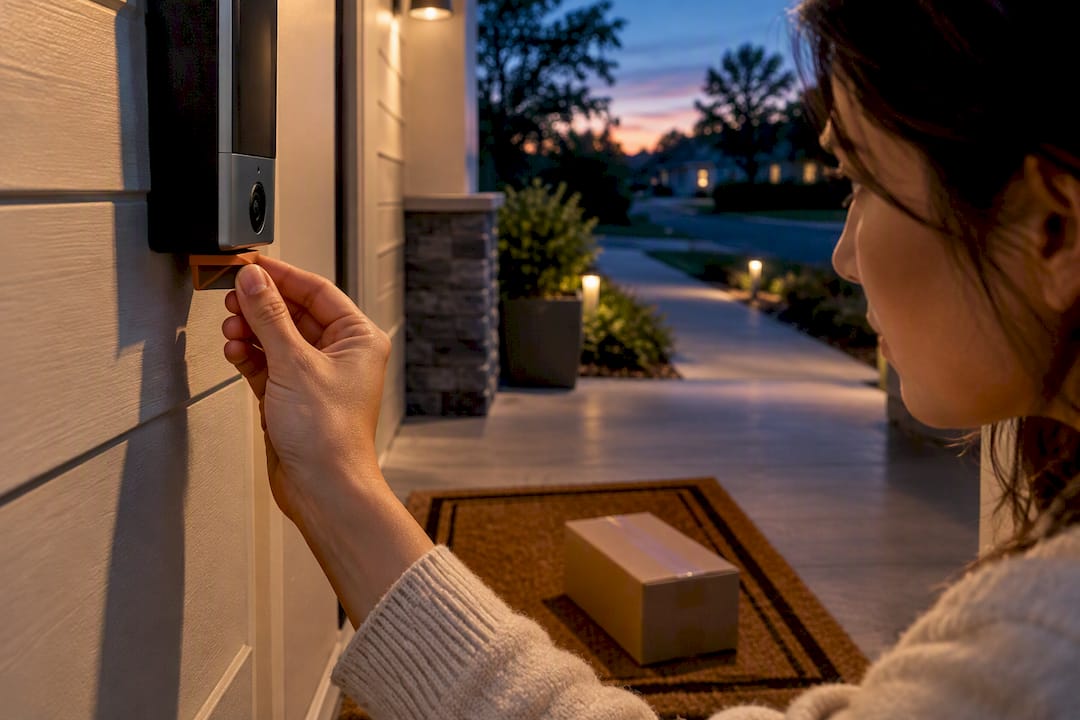
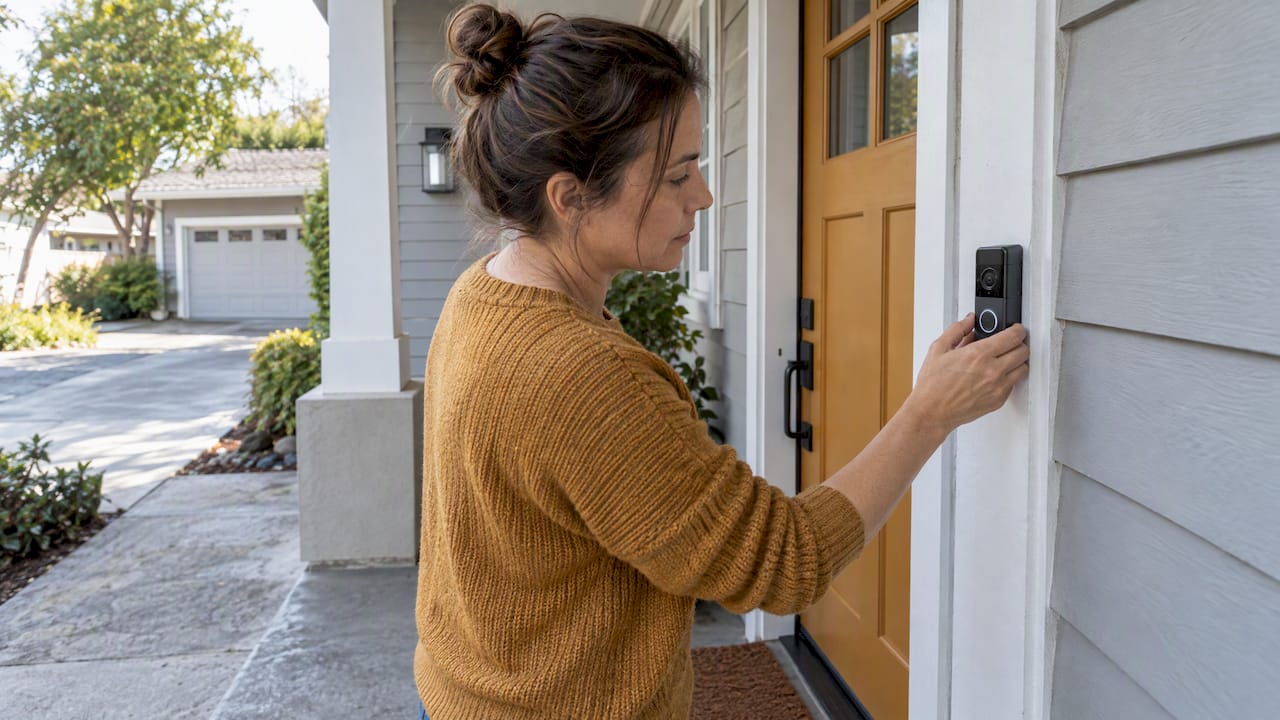
For most front doors, a doorbell camera with roughly 150° to 170° horizontal field of view, mounted about 48 to 52 inches high and tilted slightly downward, gives you the best balance of face identification and package visibility. Keep your target zone within 20 feet of the lens. If your camera has a tall aspect ratio or you mount it higher than that, you’ll want to adjust the tilt to compensate.
TL;DR:
- Mount your doorbell camera between 48 and 52 inches high to optimize face and package capture, with adjustments made for tilt if mounted higher.
- A horizontal field of view of 150° to 170° and a vertical view suitable for at least 20 feet ensure reliable identification of visitors and delivery items.
- Wider horizontal angles often come with fisheye distortion, which can be mitigated by proper mounting tilt and selective software correction.
- Higher aspect ratio cameras (such as 3:4 or 1:1) maintain more vertical coverage, helping to see packages and feet without lowering the camera.
- Narrow motion zones and nighttime infrared illumination can affect the effective coverage and clarity, so customize settings based on your placement and lighting conditions.
Field of view describes how much area your camera sees, and it’s measured on three axes: horizontal (side to side), vertical (top to bottom), and diagonal (corner to corner). Spec sheets love to lead with the diagonal number because it’s the biggest, flashiest figure. That’s also the number that tells you the least about what actually matters for a front door.
Aspect ratio ties these axes together. A camera with a 16:9 aspect ratio (like a standard TV screen) is wide and short, which is great for seeing who’s approaching from the driveway, but often crops out anything low, like a package on the porch. A 3:4 or 1:1 aspect ratio flips that priority, giving you a taller frame that captures head-to-toe views and whatever’s sitting at your visitor’s feet.
Here’s a simple way to picture it: a 160° horizontal, 16:9 camera might show you three people walking up the driveway but chop off the bottom half of the closest one. A 160° horizontal camera with a taller sensor keeps that same width while adding the vertical room to see hands, feet, and boxes. Same horizontal number, very different usefulness.
Most doorbell cameras on the market list a horizontal field of view somewhere between 140° and 180°, and CNET’s testing confirms that wider diagonal designs (closer to 180°) trade face size for coverage. Vertical field of view is almost always the smaller, quieter number on the spec sheet, and it’s the one that determines whether you catch feet and parcels.
Here’s what that plays out to in real distances:
At 3 feet, a wide angle doorbell camera captures a visitor’s full body easily, since almost any FOV handles close range well. At 6 feet, that same camera starts cropping the top of a tall visitor’s head or the bottom of a package on the mat, depending on tilt and mounting height. At 15 to 20 feet, a narrower vertical FOV means you’re likely seeing a strip of the yard or sidewalk rather than a usable, identifiable frame.

A wider horizontal number doesn’t fix a narrow vertical one. A camera boasting 170° horizontal coverage can still miss a package sitting directly below the lens if the vertical field of view wasn’t designed with that in mind.
Mounting height matters more than almost any other setting you’ll touch. Google Nest’s placement guidance recommends roughly 4 feet for doorbell cameras specifically, since a lower position helps with both face and package detection, while general detection accuracy holds up best within about 20 feet.
Independent installation guides converge on a slightly higher sweet spot: 48 to 52 inches, or about 120 to 130 centimeters, which balances face capture against parcel visibility. If you have to pick one number, aim for 50 inches (about 125 centimeters).
Here’s how to get the placement right:
For a full walkthrough of measuring height and tilt together, our guide on doorbell camera angle covers the process step by step.
Pro Tip: Test your placement at dusk, not just midday. Shadows and glare change dramatically as the sun drops, and a mounting angle that looks perfect at noon can wash out or backlight a visitor’s face by evening.
A tall aspect ratio (3:4 or 1:1) versus a wide 16:9 frame is the single biggest hardware decision affecting your doorbell camera viewing range. The taller ratio keeps more vertical real estate in frame at the same mounting height, which is exactly what you need to see a package without lowering the camera or adding a steep tilt.
Dual-camera doorbells solve this differently: a secondary, downward-facing sensor handles the porch floor while the main lens keeps its wide, standard framing for approach and face capture. One review found a dual-camera design reliably caught packages across repeated delivery tests, without any mounting compromise.
If you’re renting, mounting height is fixed, or you just don’t want to drill a new hole, a tall-aspect or dual-camera model is worth the premium. If you own the entry and can adjust height freely, a $10 wedge bracket solves the same problem for less money.
Battery-powered doorbell cameras often default to narrower motion detection zones to conserve power, which means your camera might have a wide field of view but only actively record a slice of it. That’s a deliberate tradeoff, not a defect, and it’s worth checking your app’s motion zone settings rather than assuming the full FOV is always active.
Night vision adds another layer. Infrared illumination has its own cone, and it doesn’t always match your daytime field of view. A steep downward tilt aimed at catching packages can leave the approach path dark at night, even though it looks fine during the day.
Start with a wider motion zone and narrow it only if you’re getting false alerts from the street or sidewalk. If you’re troubleshooting battery drain, our breakdown of battery sizes and equivalents is a handy reference for replacement options across smart home devices.
Most FOV complaints trace back to one of three fixable placement issues:
IR falloff (dark edges at night despite good daytime coverage) usually means the tilt is too steep for the infrared cone. Leveling the tilt by a few degrees often restores even nighttime lighting. For details on getting height and distance right during the install itself, see our doorbell camera placement guide.
If none of these fixes solve your blind spot, a small secondary camera aimed at the porch floor is a reasonable add rather than fighting your main doorbell’s geometry.
A wide field of view is only useful if the resolution can back it up. Stretching 170° of horizontal coverage across a low-resolution sensor spreads the same pixel count over a bigger area, which means each face or package occupies fewer pixels and gets blurrier as distance increases.
This is why two cameras with identical horizontal FOV specs can produce very different results. A 1080p sensor pushed across a wide frame will often show a recognizable silhouette at 15 feet but an unreadable face. A 2K or higher sensor covering that same angle holds enough detail to identify features at the same distance, because there’s more pixel density to work with.
Sensor quality matters just as much as raw resolution. Low-light performance, HDR handling for backlit porches, and how the camera manages high-contrast scenes (bright sky behind a dark visitor) all affect whether that resolution translates into a usable image. A camera can list an impressive megapixel count and still produce a washed-out, useless clip if the sensor struggles with your porch’s actual lighting.
For identification purposes specifically, prioritize resolution and sensor quality over chasing the widest possible FOV number. A narrower, sharper frame that clearly shows a face beats a sweeping, blurry one that technically captures more area. If you’re choosing between two cameras with similar price points, the one with better low-light sensor performance will usually serve you better than the one with a few extra degrees of horizontal coverage.
Cameras with very wide fields of view (especially anything approaching 180°) rely on fisheye-style lenses to physically bend that much visual information into one frame. That bending is what causes the curved, stretched look at the edges of wide angle doorbell camera footage, where straight lines (a fence, a walkway edge) bow outward instead of running straight.
The distortion isn’t just cosmetic. Objects and faces near the edge of a fisheye frame appear smaller and more compressed than objects in the center, which can make identification harder exactly where visitors often stand, off to one side of the door rather than dead center.
Some manufacturers apply software correction to flatten the edges, trading a bit of the raw wide angle for a more natural-looking image. That correction usually costs a small amount of processing time or a slightly cropped final frame, but it’s worth it for identification purposes.
You can partially work around distortion without buying new hardware. Mounting height and tilt affect where the “sweet spot” of the fisheye lens (the center, least distorted section) actually points. If your camera consistently shows a warped face near the edge, a small angle adjustment often shifts that visitor into the cleaner center zone of the frame instead. Community field of view testing on forums like Arlo’s user community backs this up. Real-world measured coverage frequently differs from the manufacturer’s stated spec, which is exactly why a post-install walk test matters more than trusting the number on the box.

A wide field of view that spills onto a neighbor’s porch, window, or yard creates a real privacy problem, not just an ethical gray area. Most areas draw a legal line around recording spaces where someone has a reasonable expectation of privacy, and a neighbor’s front door usually qualifies even though yours might not.
Audio recording adds another layer that trips people up. Some regions require consent from all parties before audio is recorded, which matters if your doorbell camera’s microphone range extends further than its visual field of view. Check your local rules before enabling always-on audio.
Practical placement is your best defense here. If your 160° horizontal field of view captures a shared driveway, the interior of an adjacent home, or a public sidewalk beyond what’s reasonably needed to see your own entry, consider narrowing your motion zone or physically adjusting the mount rather than relying on the camera’s default framing. For a closer look at how this plays out for U.S. homeowners specifically, our article on doorbell camera laws walks through the details.
Privacy concerns aren’t just legal risk, either. They’re part of why some longtime Ring users have started disconnecting devices, citing discomfort with cloud data collection and expanded sharing features rather than the hardware itself, according to BGR’s reporting. A camera that respects boundaries by design tends to earn more trust from the people who live near it, not just the person who installed it.
Manufacturer placement guides get you most of the way there, but they’re written for an average door on an average house. Your door isn’t average. It’s set back three feet further than your neighbor’s, or it’s got a porch light throwing glare at 6 p.m., or the delivery driver always drops packages two feet to the left of where you’d expect. The 48 to 52 inch range and the 150° to 170° horizontal FOV sweet spot are proven starting points, backed by both Google Nest’s own guidance and independent testing. They’re not a guarantee.
What actually closes the gap between spec sheet and real coverage is the walk test: standing at 3, 10, and 20 feet and checking what the camera actually sees, not what the box promised. Sabezon designed the Entryx Smart Doorbell Camera around exactly this reality, with mounting hardware that makes tilt adjustment simple instead of a project. Most FOV complaints aren’t camera problems. They’re five-degree tilt problems, and they take five minutes to fix once you know where to look.
— Tony
Some smart home tech is designed around mounting realities rather than relying on spec sheet numbers that may not hold up at longer distances. If you’re shopping for a new camera or fixing a coverage gap on your current one, our Smart Home Tech collection carries doorbell cameras and mounting accessories chosen for real-world face and package capture, not just wide-angle bragging rights.
The Entryx Smart Doorbell Camera is built with the height and tilt guidance from this article already factored into its mounting hardware, so you’re not fighting the bracket to get the angle right. If you’re weighing whether a hardware upgrade or a simple wedge bracket solves your specific blind spot, our breakdown of doorbell camera cost walks through both paths and what each one runs. Browse the full collections page to compare options, and get your entryway covered properly instead of guessing at it.
Placement recommendations draw on Google Nest’s official guidance, Ring’s positioning docs, and CNET’s doorbell camera testing.
Ring’s doorbell lineup generally falls within the common industry range of 140° to 180° horizontal field of view, depending on the model. Ring’s own placement guidance stresses that correct mounting height matters as much as the raw angle for getting usable footage.
Several models across the market advertise up to 180° diagonal field of view, typically achieved with a fisheye-style lens. That wider coverage usually comes with more edge distortion and smaller-looking faces near the frame’s borders, so check vertical FOV and resolution too, not just the headline number.
For doorbell-style security cameras aimed at identifying visitors and packages, 150° to 170° horizontal FOV paired with a taller vertical field of view covers most front-door situations well. Mounting height in the 48 to 52 inch range, as recommended by placement guides, matters as much as the angle spec itself.
Some longtime users have disconnected Ring devices over privacy concerns tied to cloud data collection and expanding data-sharing features, not dissatisfaction with the camera hardware itself, according to BGR’s coverage. Homeowners concerned about this tend to look toward local-storage options or tighter privacy settings rather than abandoning smart doorbells altogether.